Three Places Called 'Toad'
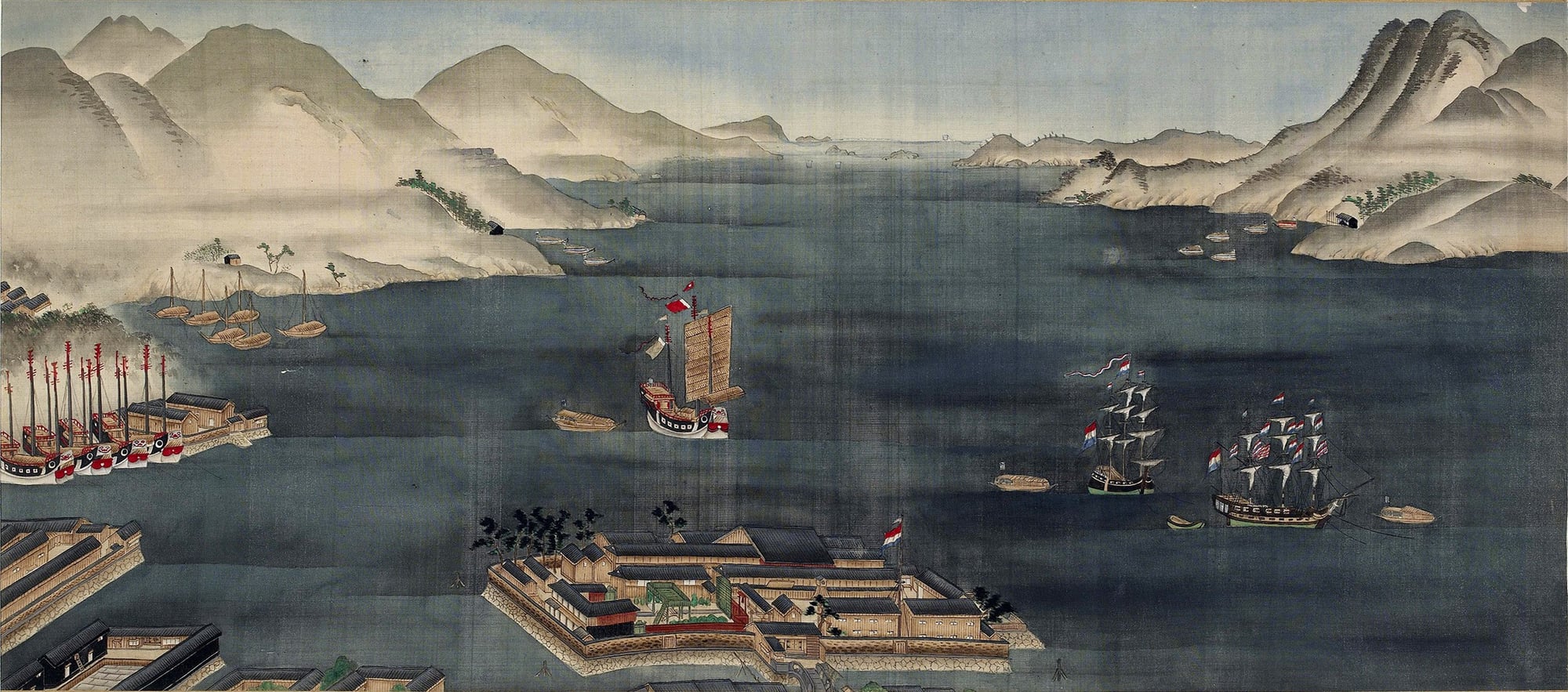
Painting: artist unknown, ca. 1800–1825, British Museum (public domain), from Kaiser et al. 2026, Zootaxa
In 1826 a German zoologist printed a new name for a Japanese toad, Bufo praetextatus. Directly under it, centred on its own line, he added three strange words: Vitikairu, et Fikikojeru et Nakfudo Jap.
For almost two centuries, readers took these to be three places in Japan where the toad had been found. Nobody could match them to any real place. When Hinrich, our Kyoto colleague Kanto Nishikawa and I read the text closely, we found out why. They are not places at all. They are Japanese words for a toad.
A familiar name under threat
Japan's common toads are big, warty animals. Scientists now recognize three species: Bufo japonicus, B. formosus and B. torrenticola. They hybridize where they meet, which has made their naming complicated. Bufo japonicus, named by Coenraad Temminck and Hermann Schlegel in 1838, is the name that most scientists have used for a long time, and it is the one on the Herpetological Society of Japan's list of standard names.
But the International Code of Zoological Nomenclature, the rulebook that zoologists everywhere follow when naming animals, has a simple main rule: the oldest properly published name wins. Bufo praetextatus was published in 1826, twelve years before japonicus. A 2022 study confirmed that it has priority, and some online databases had already switched to it. The old, rarely used name threatened to replace the familiar one. What stood in its way was that nobody knew where its toads had come from, and the original specimens were lost.
A window through Dejima
The toads came from Japan in the Edo period, when the country was almost closed to foreigners. The only Europeans allowed to trade there were the Dutch, and only from Dejima, an artificial island of about 120 by 75 metres in Nagasaki harbour. Jan Cock Blomhoff was the director of the Dutch trading post for more than ten years, from 1809 to 1813 and again from 1817 to 1824. He was not a naturalist, but he collected whatever natural history specimens he could, and he took them home to the Netherlands.
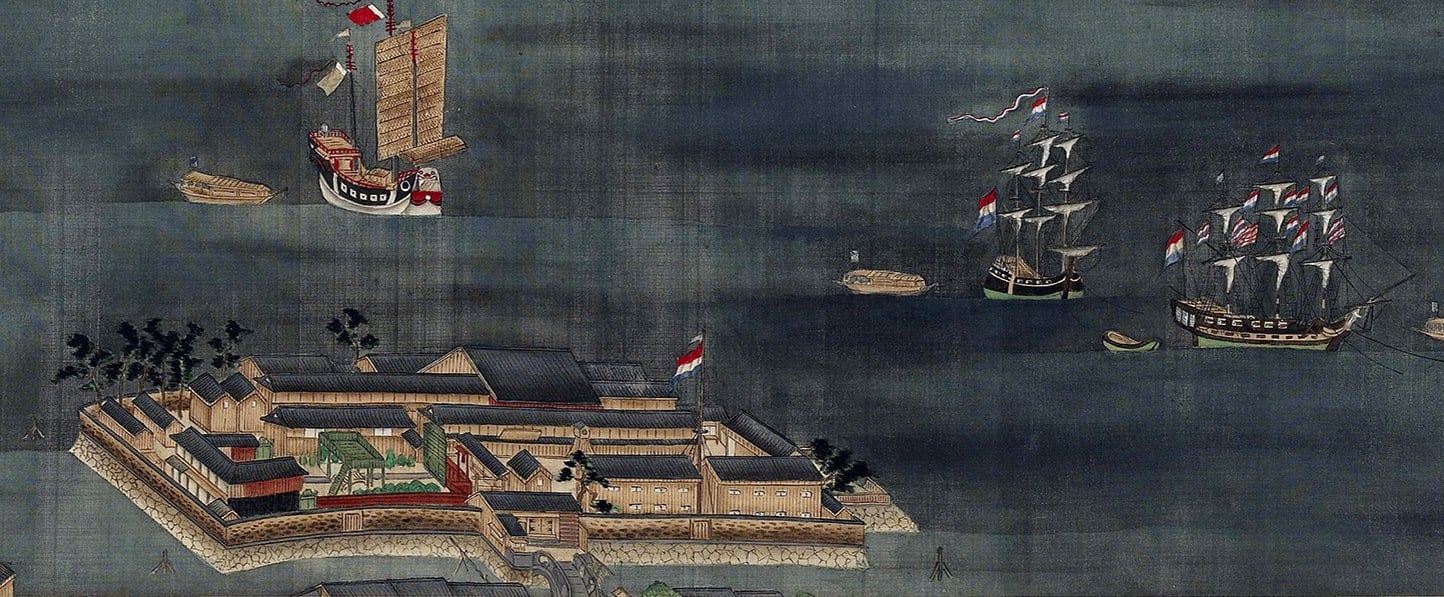
The zoologist who described his reptiles and amphibians was Heinrich Boie, a German working at the new natural history museum in Leiden. Boie had only a short time with Blomhoff's collection, because he was about to sail for the Dutch East Indies himself. He died there of malaria in 1827. His 1826 paper, published in the German journal Isis, named seven snakes and two amphibians from Japan. The two amphibians were a newt, today's Japanese fire-bellied newt, and the toad.
Boie's introduction is a small window on natural history at the time. He was surprised that some Japanese animals also lived in the Sunda Islands, such as Java, and at first he suspected the labels were wrong, until Blomhoff convinced him by the way the specimens had been preserved. He also wandered off into birds. Using waxwing skins that Blomhoff had brought back, he confirmed a claim by Philipp Franz von Siebold that the European waxwing also lives in Japan. Siebold, a German physician and naturalist, had been allowed onto Dejima as a hoogduitser, a speaker of High German. This had been mistranslated as "a Dutchman from the high Dutch mountains". As a German he was in fact there in breach of the treaty, which allowed only Dutch citizens on Dejima.
Reading Boie closely
Our starting point was modest. Boie's snakes and his newt had already been transcribed and translated. The toad had not. So we set out to transcribe it from the old German Fraktur print, translate it sentence by sentence and explain what Boie meant.
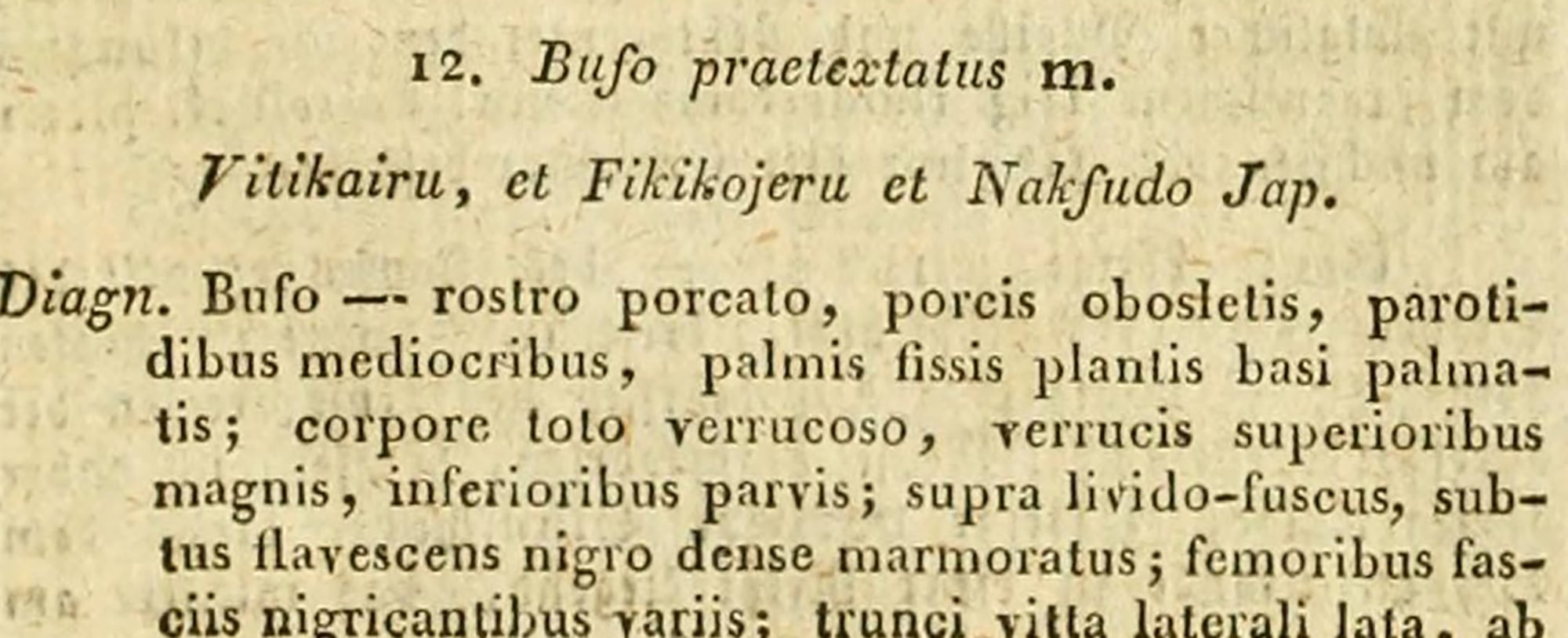
The key was to read the whole paper, not just the toad. The very first snake Boie described, the tiger keelback, has a line under its name too: "Toravebi (Tigerschlange) Jap." Tigerschlange is German for tiger snake, and toravebi is a European ear's version of the Japanese tora (tiger) plus hebi (snake). The lines under the names were not localities. They were the Japanese names that Blomhoff had reported.
So we went looking for early Japanese words for toads. More than a century before Boie, the German naturalist Engelbert Kaempfer (1651–1716) wrote in Latin of toads in the mountains of Nagasaki, "called Bitchi-garu by locals, marked with black spots". Say bitchi-garu or hiki-kaeru, a common Japanese word for a toad, to someone who does not speak Japanese, and Vitikairu is not far off. Fikikojeru matches an old or Kyushu dialect word for a croaking toad; the Dutch wrote "f" where Japanese has a strong "h". Nakfudo combines naku, to croak, with fudō, a classical word for toad. Linguists call this kind of gradual change in what a listener hears "phonetic drift".
Everywhere and nowhere
Once the three "places" were gone, only one place was left in Boie's text: Nagasaki. But he did not say the toads came from there. He said the toad was common in Japan, and even found in houses in Nagasaki. Blomhoff's material came from many parts of the country, where all three of today's species live. Boie's specimens could have been any one of them, or a mix. We searched for them, including in the old collection of Boie's brother Friedrich, now in Kiel. The four Japanese toads there were most likely sent decades later, by a German pharmacist who ran a pharmacy in Japan from 1886 to 1899.
That makes Bufo praetextatus a nomen dubium, Latin for "doubtful name". The Code defines it as "a name of unknown or doubtful application". The name was properly published, but there is no way to tell which animal it belongs to. So it cannot push aside Bufo japonicus.
Why not just pick a toad?
There is a way to rescue a name like this. One could choose a new name-bearing specimen, a neotype, say a well-preserved toad from Nagasaki. We argued strongly against it. Japanese toads fall into five genetic groups and three hybridizing species, so choosing a neotype would first need a lot of genetic work to make sure the chosen toad is not a hybrid. A careless choice could even turn formosus or torrenticola into mere synonyms of it. Such a case would also have to go to the International Commission on Zoological Nomenclature. The Commission's bulletin appears only once a year, one recent case took seven years from submission to publication, and a decision might not come before 2030.
"Just because a neotype can be designated does not mean it should be designated." — Kaiser et al. 2026
Colleagues have summed up the principle in Latin: Noli tangere nomina probata, do not touch names that have proven themselves. The people who use scientific names always outnumber the people who create them, so names should change as little as possible. And there is one more reason to keep japonicus. Both names were coined by Dutch-based scientists of the colonial era, but japonicus honours the country the toad comes from.
Our conclusion is that Bufo praetextatus should stay a nomen dubium for good, and that Japan's common toad should keep the name it has carried in science since 1838: Bufo japonicus.