Unpicking a 164-Year Tangle
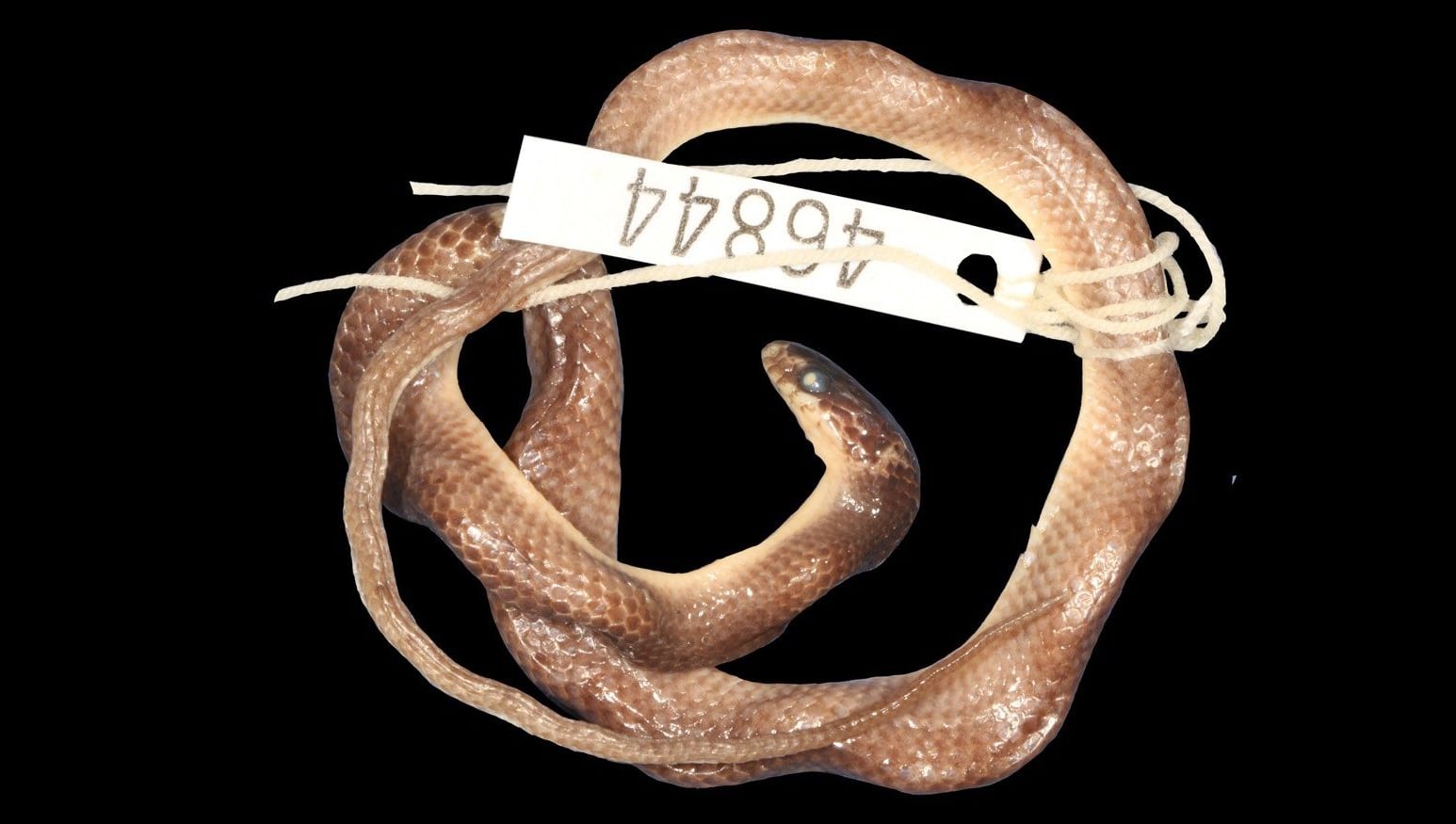
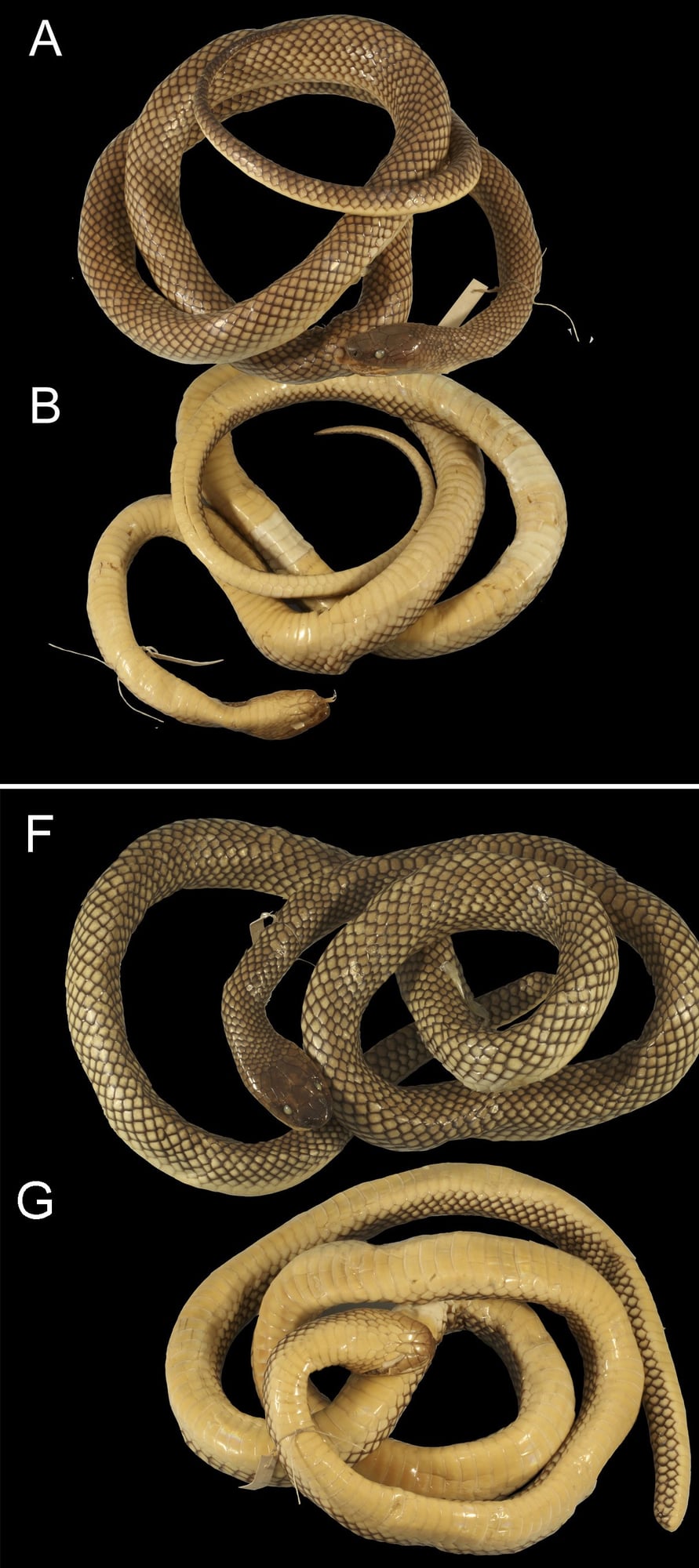
Photo: from Kaiser et al. 2018, Zootaxa
The little snake on the tag numbered 46844 is only 29 centimetres long. A doctor working for the Dutch government caught it on 22 February 1952 at Serui, on Yapen Island in western New Guinea, and it has been kept in Leiden since 1953. Since 2018, this unremarkable brown snake has carried a heavy load. It now defines a species name that was coined in 1874 for two other snakes, and those two were destroyed when Dresden was bombed in 1945.
How a snake from 1952 came to stand in for two snakes from 1873 is one small part of a much larger puzzle. That puzzle became my doctoral thesis.
Twenty-nine names
The snakes in question are the Indo-Papuan groundsnakes, genus Stegonotus. They live on the islands east of Wallace's Line, from Borneo and the Philippines to New Guinea and Australia. Many of them look alike, and that is the whole problem.
Since the genus was named in 1854, 29 species have been described in it or placed in it. When we started, only 15 of them were still considered valid. The rest had been "sunk" as synonyms, meaning extra names for a species that already had one. The original descriptions were written in Dutch, English, French, German and Italian, and the snakes were first described under eight different genus names. Authors did not even use the same words for the same scales. Nobody had ever gone back to the beginning and checked every name against the actual specimens it was based on.
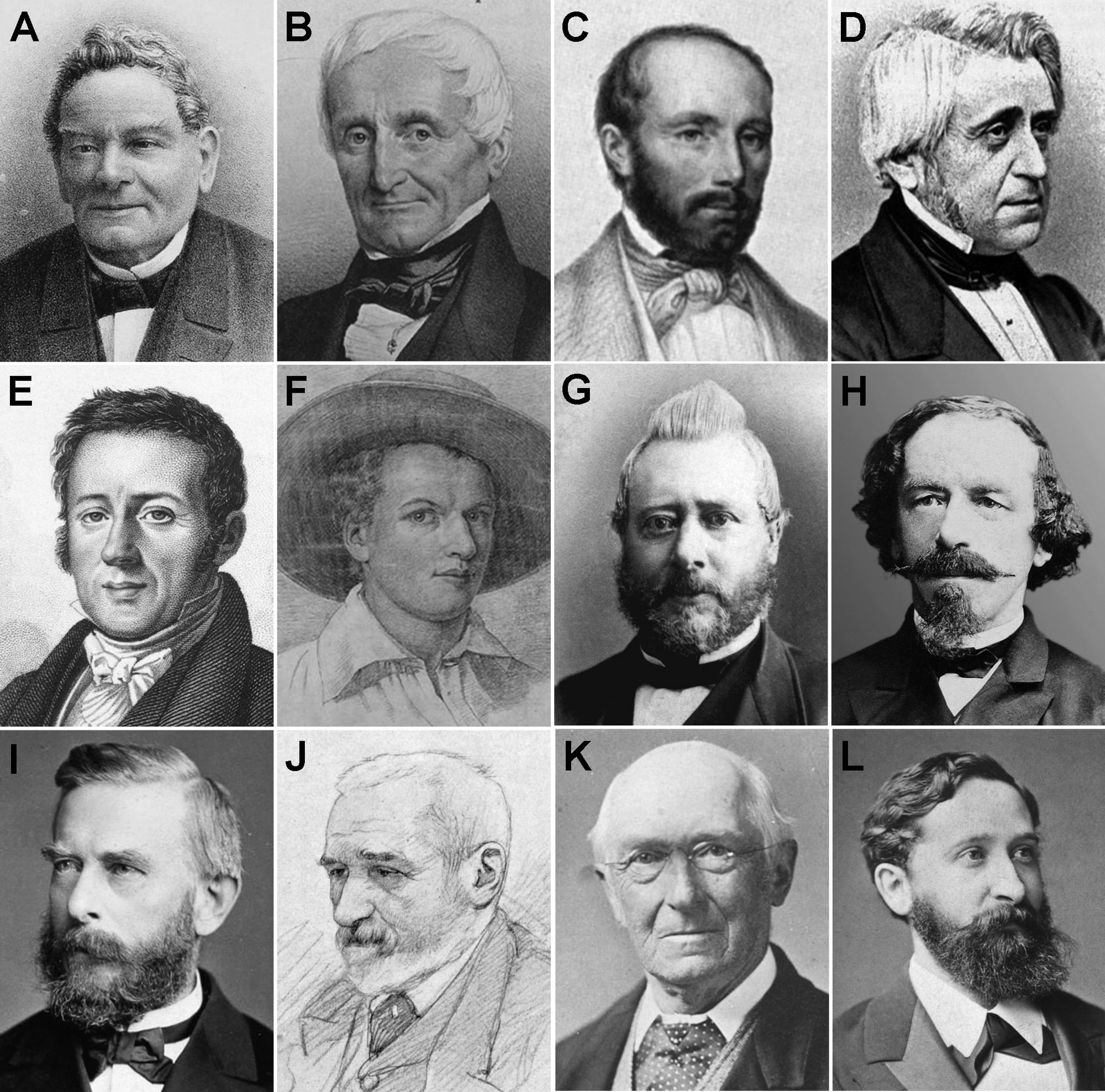
So Hinrich, Mark O'Shea and I did exactly that. It became my doctorate at Philipps-Universität Marburg in Germany, which I began in 2012. We examined about 1,500 museum specimens held in more than 30 collections around the world. We traced where every original specimen had been collected, by whom, and when, and we tracked down portraits of the naturalists who had named and collected them. The result, published in Zootaxa in 2018, ran to 73 pages.
What is a Stegonotus?
The genus was created in Paris by Constant Duméril, Gabriel Bibron and Auguste Duméril, in the seventh volume of their great encyclopedia of reptiles. They defined it by its teeth: long, smooth teeth in the upper jaw, separated from the others by a small gap. That is not easy to check in hundreds of pickled snakes whose jaws no longer open.
There is an irony here. The question "What is a Stegonotus?" was where our research began. After examining about 1,500 specimens, we still could not find a feature that clearly separates these snakes from the wolfsnakes, genus Lycodon. Even the founders blurred the line: in the very book that created Stegonotus, they described two of its species as wolfsnakes. The question is still open.
Wrong addresses
Much of the confusion came from labels that told the wrong story. The first Stegonotus was said to come from Java. It didn't.
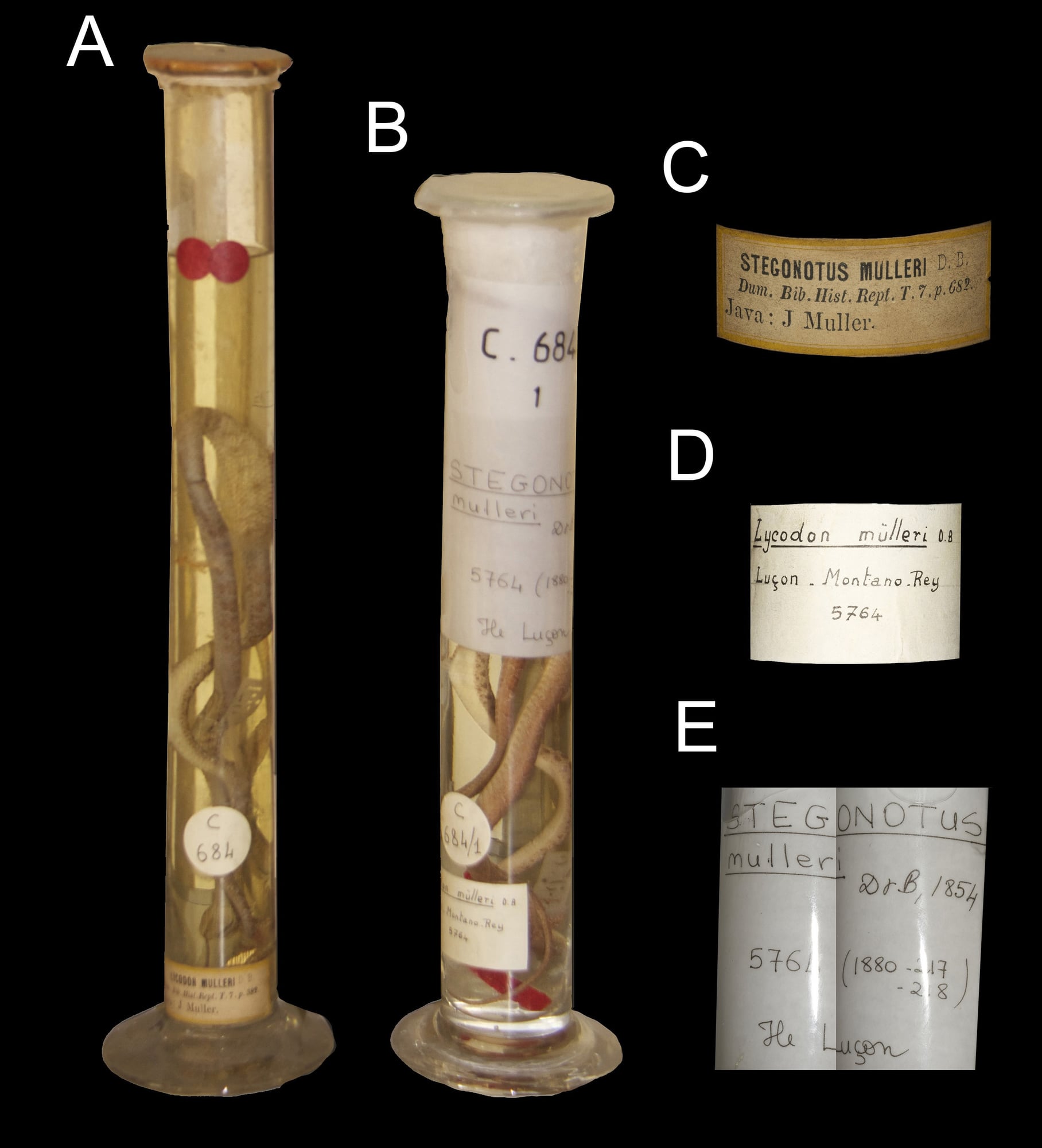
In the Paris museum, one tall glass jar holds the original specimens of two different snakes, both named muelleri and both labelled "Java". One is a groundsnake from the southern Philippines, the other a wolfsnake from the northern Philippines. Neither species lives on Java. Both were named for Johannes Müller, a famous Berlin physiologist who received specimens from students, dealers and other museums. At the time, most shipments from the region passed through the port of Batavia (now Jakarta) on Java. The port seems to have been written down instead of the place where the snakes were caught.
Place names could be a trap too. One species was described from "Hâvre Dorey" in New Guinea, which had been read as a town on Yapen Island. In fact it is the bay at Manokwari, on the mainland. In the language of Biak Island, dore-ri means "bay", so the old colonial name "Dorery Bay" really means "bay bay".
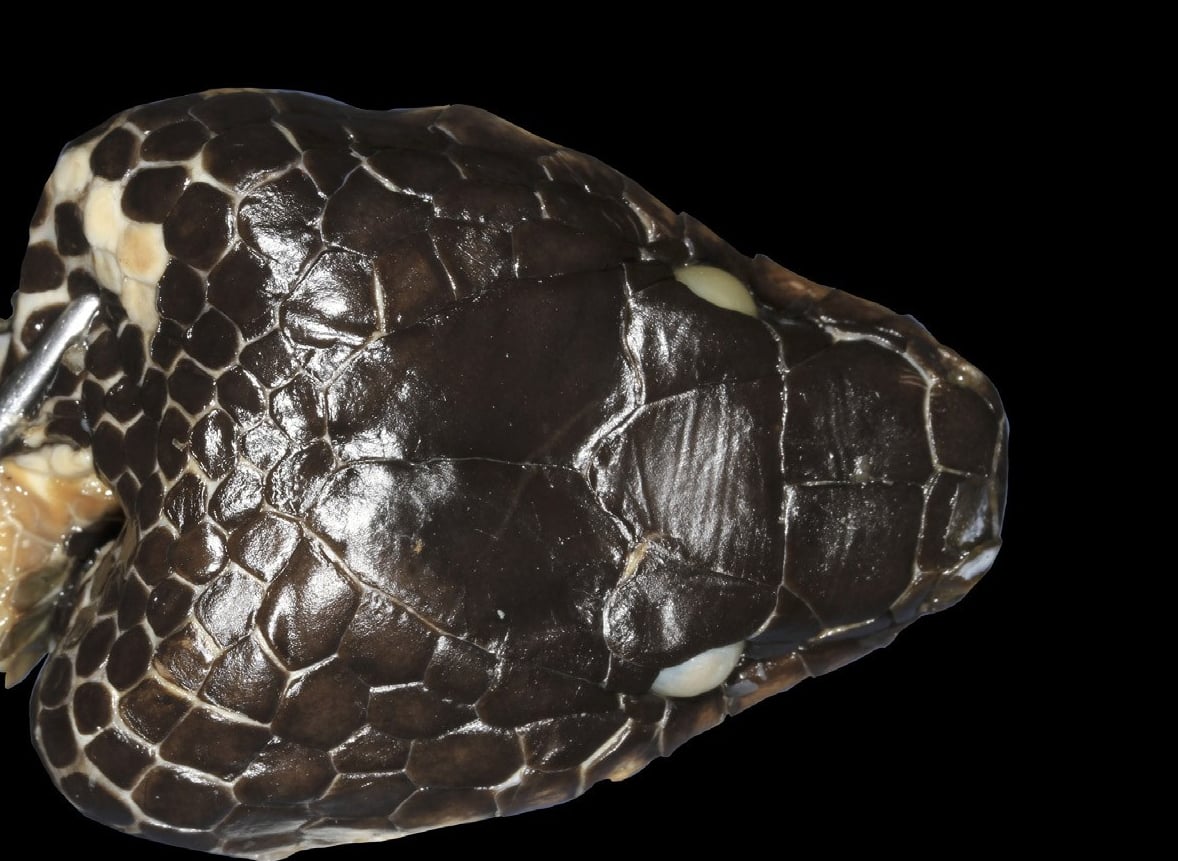
In Vienna, the jar of one snake simply says "Fundort?" (locality?) and "Coll.?" (collector?). Museum staff there helped us search the archives. Letters from the anthropologist Rudolf Pöch, who visited New Guinea in 1904, showed that the snake came from Monumbo, the hills behind a harbour called Potsdamhafen. Neither name appears on modern maps. Another snake from the same shipment, Stegonotus poechi, had been mentioned only once in the scientific literature since it was named in 1924. It turned out to be a valid species.
Sometimes a name was simply spread too thin. Stegonotus modestus had been applied to snakes across New Guinea. We showed that it really belongs only to the central Moluccan islands of Ambon, Buru and Seram, where the adults have a pale band across the neck that no other groundsnake seems to have. That meant most earlier identifications of "modestus" were wrong.
A stand-in for a lost snake
In 1873 the German naturalist Adolf Bernhard Meyer collected snakes around Cenderawasih Bay. He named two new species, Lycodon magnus ("big") and Lycodon parvus ("small"). He then became director of the natural history museum in Dresden, and his specimens were kept there. In February 1945, Allied bombing raids destroyed most of the Dresden museum's reptile collection, and with it the two snakes of parvus.
Without them, nobody could say what parvus really was. Meyer's short description did not clearly separate it from other New Guinea groundsnakes. Yet the name had been written on dozens of specimens from New Guinea and Australia, with no way to check it.
This is exactly the situation a neotype is for. The International Code of Zoological Nomenclature, the rulebook zoologists everywhere follow when naming animals, allows a new name-bearing specimen to be chosen when the originals are lost and the meaning of the name is in doubt. The rules are strict. We had to show that we had asked the museum in Dresden and that the originals were gone. The new specimen had to fit the original description, come from as close to the original place as practical, and be kept in a public museum.
The snake on the tag 46844 met all of these. It came from Serui, about 50 km from the spot on Yapen where Meyer collected, in the same kind of lowland habitat. It matched Meyer's description in most details, from the shapes of the head scales to the single plate in front of the vent. Its tail was a little shorter than in Meyer's specimen, but his snake was probably a male, and in several groundsnake species males have longer tails. It was collected by Dick Leiker, a physician who worked on leprosy in New Guinea from 1949 to 1958. Sixty-six years later, his small snake became the anchor for Stegonotus parvus.
The people behind the names
Working through the history, I came to know the people as well as the snakes. Nelly de Rooij, who named Stegonotus florensis in 1917, was curator of the zoological museum in Amsterdam and wrote the first complete accounts of the reptiles of the Indo-Australian islands. Rules that discriminated against women followed her throughout her career, and in 1922, aged only 39, she resigned after administrative reforms that were unfair to women. That ended her research career. The missionary George Brown, who collected groundsnakes on Duke of York Island in the late 1870s, was a close friend of Robert Louis Stevenson, the author of Treasure Island. The Australian naturalist William Macleay named a species from a snake that reached him in "an earthenware jar" brought by a plantation overseer. And for Salomon Müller, who collected the original specimens of two species, no portrait of any kind seems to exist.
"Alongside of the scientific aspects of this work, we were also forced to become sleuths, to uncover some of the historical connections …" — Kaiser et al. 2018
Getting it right, twice
By the end we recognized 22 species. We brought several old names back from the synonym pile, including S. lividus from tiny Semau Island off Timor, and we chose lectotypes for several names so that each rests on one specimen.
A monograph of 73 pages is never quite finished. Careful readers, especially Glenn Shea in Sydney and Roy McDiarmid in Washington, sent us corrections, and in 2019 we published a short list of Corrigenda and Addenda. Some were small, like a stray letter "x" where a symbol belonged. Others were real surprises. The London dealer named on the label of one Australian specimen had been a surgeon who never travelled to Australia during his medical career, so he could not have collected it. It probably came from the stock of a natural history agency he had bought, and its real collector is unknown. We also learned that two other authors had already chosen a lectotype for Stegonotus reticulatus back in 1985. Under the rules, their choice counts, not ours. They had picked the male with a broken tail, while we had preferred the female with a complete one, so we now recommend that anyone studying the species looks at both.
We had missed something else too: a third original specimen of S. lividus, hiding in Paris. That is a story of its own.
The thesis was finished in 2019, but the work was not. More than 1,000 groundsnakes in museum collections were still labelled simply "Stegonotus sp.", species unknown. With the old names finally pinned to real specimens, we could start naming the new ones. We have since described three, from the Bird's Head Peninsula of West Papua, from the mountains of Borneo and from the south coast of Timor-Leste.
The papers
- (2018) The taxonomic history of Indo-Papuan groundsnakes, genus Stegonotus Duméril et al., 1854 (Serpentes, Colubridae), with some taxonomic revisions and the designation of a neotype for S. parvus (Meyer, 1874) Zootaxa 4512(1): 1–73
- (2019) Corrigenda and Addenda to the article “The taxonomic history of Indo-Papuan groundsnakes, genus Stegonotus Duméril et al., 1854 (Colubridae), with some taxonomic revisions and the designation of a neotype for S. parvus (Meyer, 1874)” by Kaiser et al. (2018) Zootaxa 4615(2): 392–394
- (2019) History and taxonomy of Stegonotus Duméril et al., 1854, a genus of Indo-Papuan groundsnakes (Serpentes, Colubridae) Doctoral thesis, Philipps-Universität Marburg, Germany