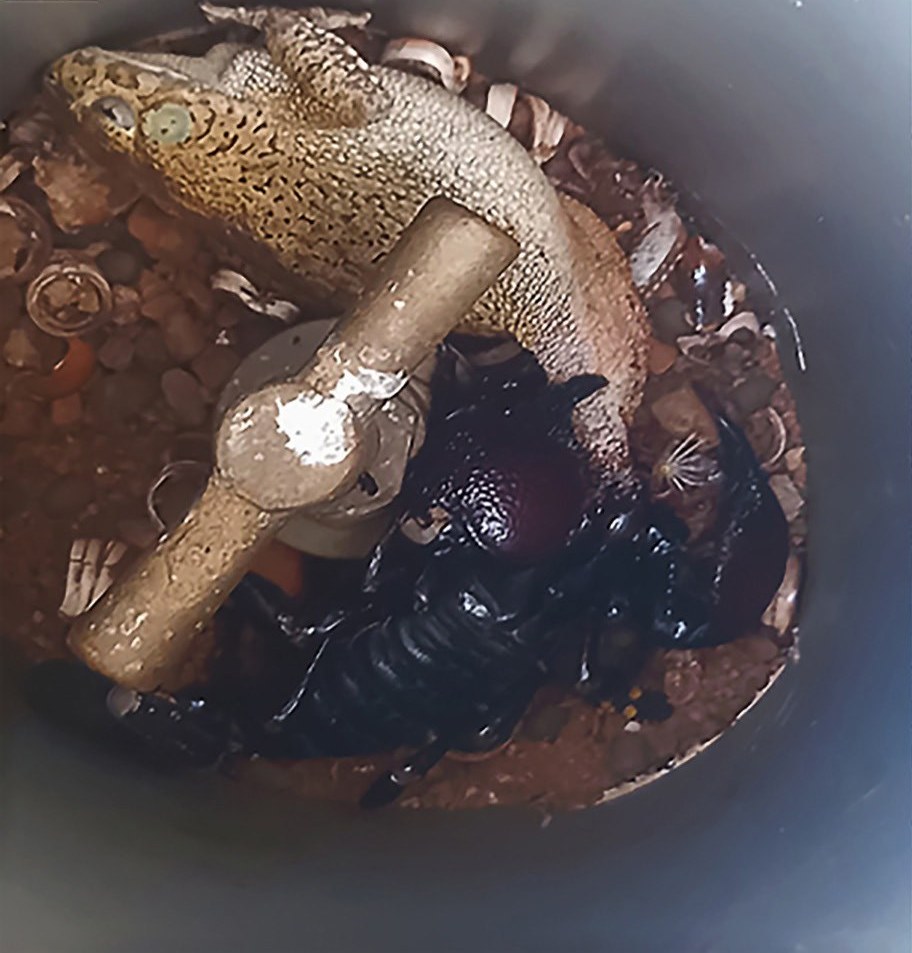
Trapped in a Pipe
Photo: from Ofori et al. 2022, Herpetology Notes
At about eight o'clock in the morning on 7 June 2021, in a garden plot at Oyibi on the Accra Plains of Ghana, someone looked down into a short length of grey plastic pipe. At the bottom sat a toad. Wrapped around the toad's right hind foot were the pincers of a large, glossy black scorpion. The scorpion was already eating.
The toad was still alive and struggling. It could not get away. When my co-authors checked again the next day, the toad was dead, and the scorpion was still feeding.
The hunter and the hunted
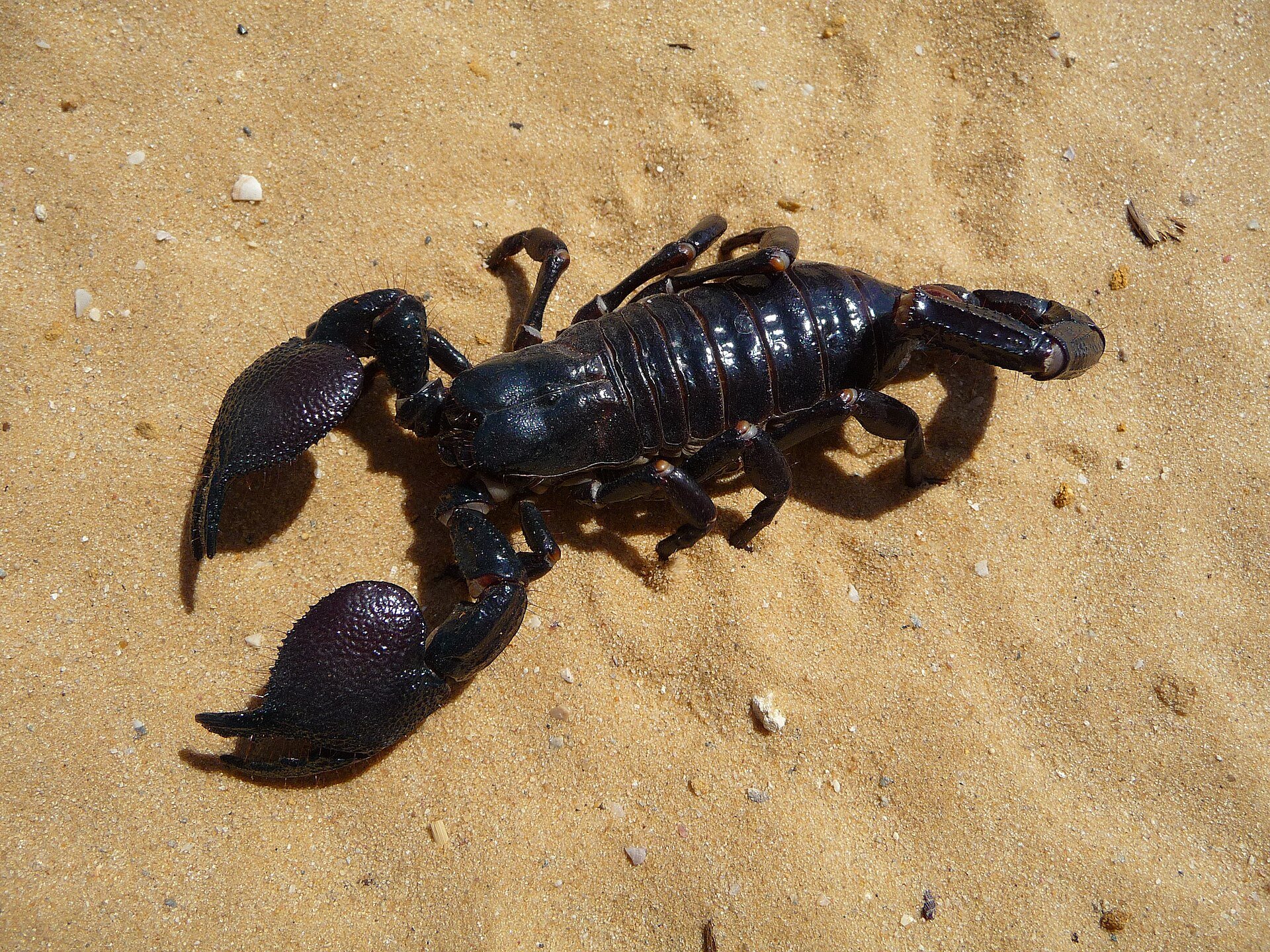
The scorpion was an Emperor Scorpion, Pandinus imperator: a heavy-bodied, dark West African species with broad, bumpy pincers. Judging from other scorpions collected in the same garden plot, this one was about 65 mm long in the body, with a tail of about 75 mm and pincers about 30 mm long. It weighed about 16 grams.
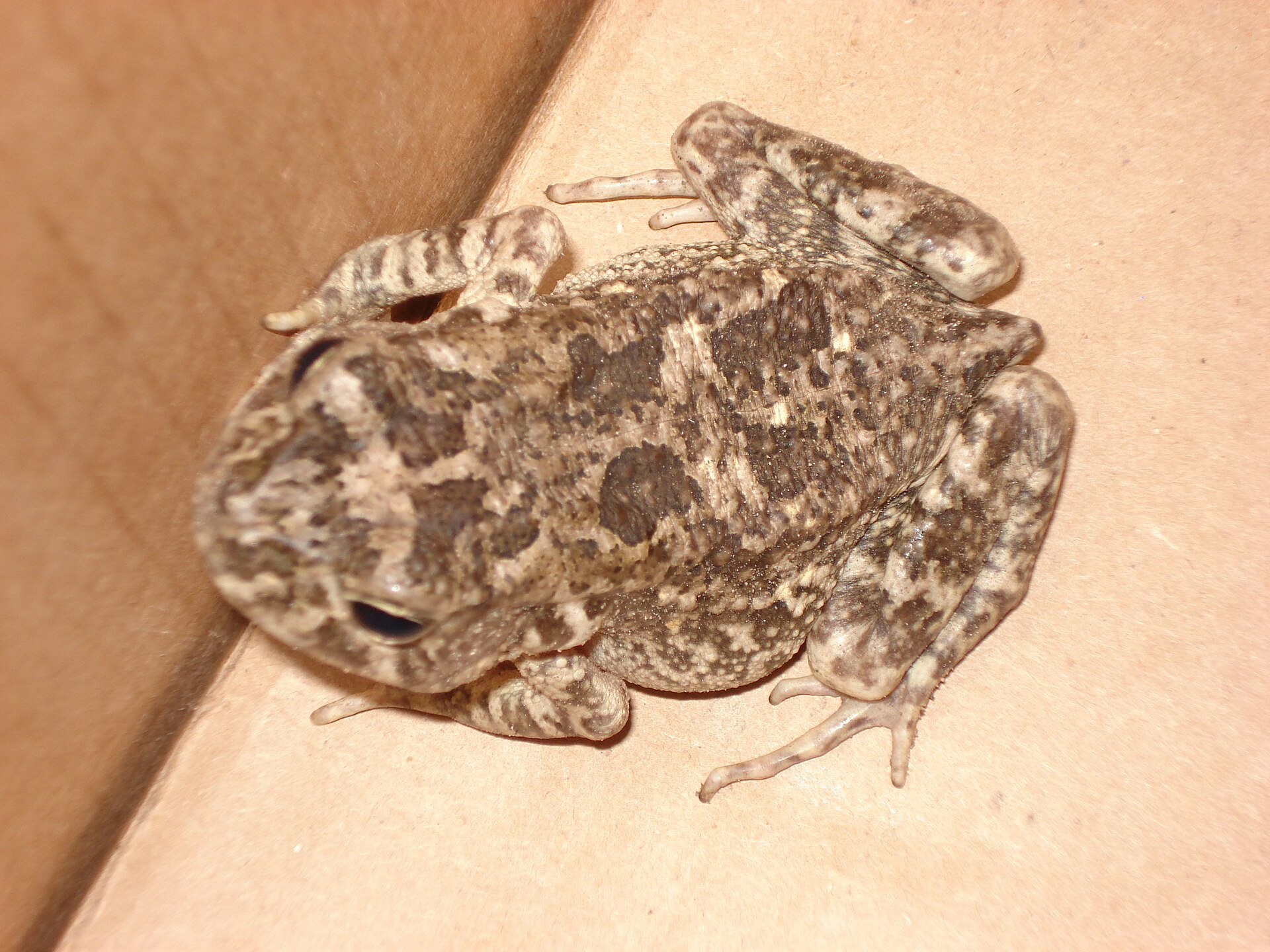
The toad was an adult female Northern Flat-backed Toad, Sclerophrys maculata, a toad found widely across Africa south of the Sahara. She measured about 70 mm from snout to vent (the opening under the rear of the body; herpetologists measure frogs and toads this way) and weighed about 30 grams.
In other words, the scorpion had caught a toad nearly twice its own weight.
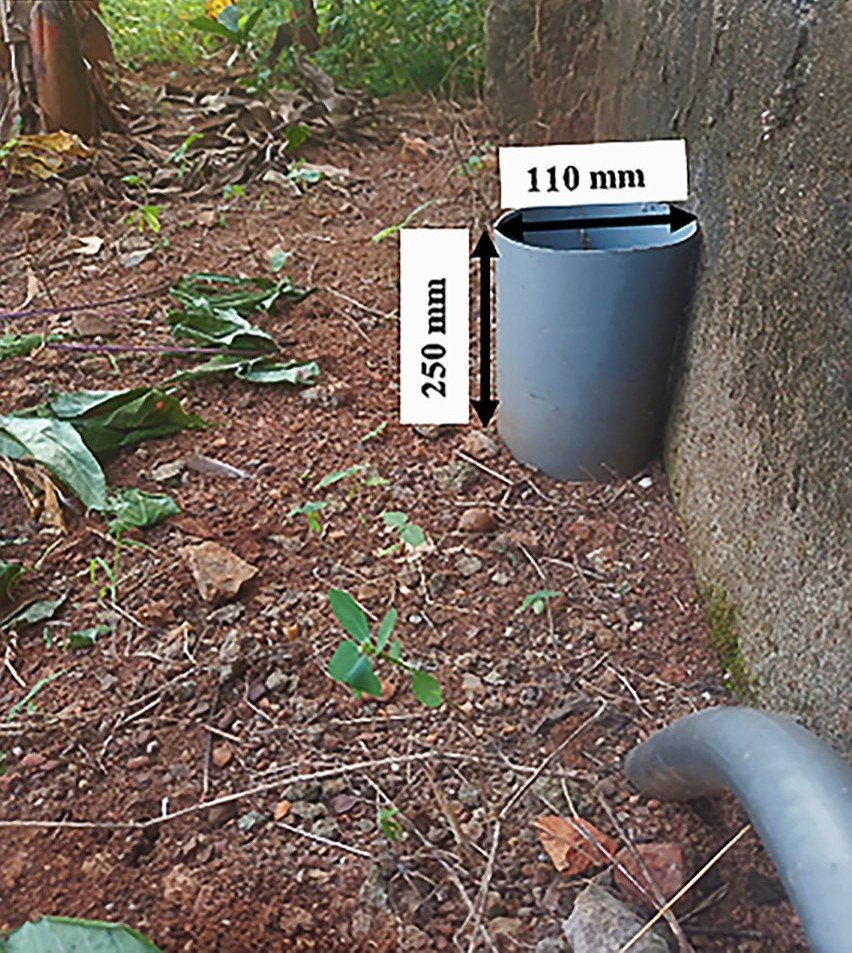
A pipe with no way out
Why couldn't a toad that size simply hop away? The answer is in the second photo the team took. The pipe was a piece of PVC tubing standing around a garden tap, about 110 mm across and 245 mm tall. For a toad, that is a small, deep well with smooth walls. Once the scorpion had hold of it in that tight space, there was nowhere to go.
So this was probably not a typical hunt. Scorpions are ambush hunters that mostly eat insects and other invertebrates, and published cases of scorpions eating frogs or other animals with backbones are generally opportunistic: the right prey in the wrong place at the right moment. Here, the pipe did half the work.
Poison that didn't work
The more surprising part is that the scorpion ate the toad at all. Toads defend themselves with poison. Behind the eyes, a toad has a pair of swollen glands, the parotoid glands, that ooze a potent toxin called bufotoxin when the animal is attacked. Many predators learn to leave toads alone, and some die from trying.
This scorpion did not seem bothered. It was still eating the next day. We do not know whether Emperor Scorpions are resistant to bufotoxin or whether this one simply avoided the glands, but whatever the reason, the poison did not stop it.
Invertebrates that eat frogs
We usually think of frogs and toads as the ones doing the eating. They are voracious insect-eaters, and they play an important role in moving energy and nutrients through their ecosystems. But the food chain runs both ways. Frogs and toads are eaten by snakes, birds, otters and many other vertebrates, and also, now and then, by invertebrates.
In the Americas this has been documented several times. A large hunting spider, Ctenus medius, has been seen eating frogs in southeastern Brazil, including a critically endangered species found only on one island. In the West Indies, a red scorpion was caught eating a Cuban Treefrog. Farther afield, on the Columbretes Islands off the coast of Spain, scorpions have been recorded eating lizards.
In West Africa, though, as far as we could find, no one had ever documented a scorpion eating a frog or a toad. This garden plot in Ghana provided the first record of an Emperor Scorpion preying on a Northern Flat-backed Toad.
My part
This observation belongs to Benjamin Yeboah Ofori, John Bosu Mensah and Daniel Korley Attuquayefio of the Department of Animal Biology and Conservation Science at the University of Ghana. I joined them as a co-author on the note, published in Herpetology Notes in 2022. Short notes like this one are how a sharp-eyed observation in a garden becomes a permanent scientific record that anyone in the world can find and use.
The papers
- (2022) Predation on the Northern Flat-backed Toad, Sclerophrys maculata (Anura: Bufonidae), by the Emperor Scorpion, Pandinus imperator Herpetology Notes 15: 619–620