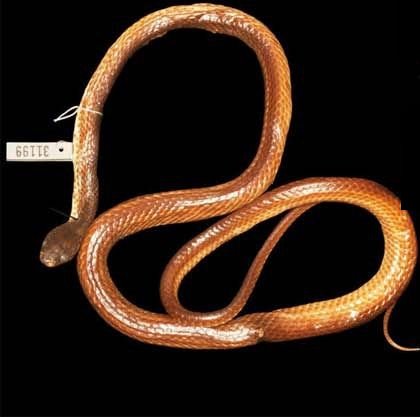
The Missionaries' Snake
Photo: from Kaiser et al. 2019, Zootaxa
In February 1953, near a village in the forests of western New Guinea, the Reverend Herbert Marcus and his wife Mieneke Marcus-van den Nieuwenhuizen collected a slender brown snake about 71 centimetres long. He was a Dutch Mennonite missionary; she worked there as a government physician. The snake was preserved and ended up in the natural history museum in Leiden, in the Netherlands. Its label named the village as "Komara" and the exact spot as "apan bebach".
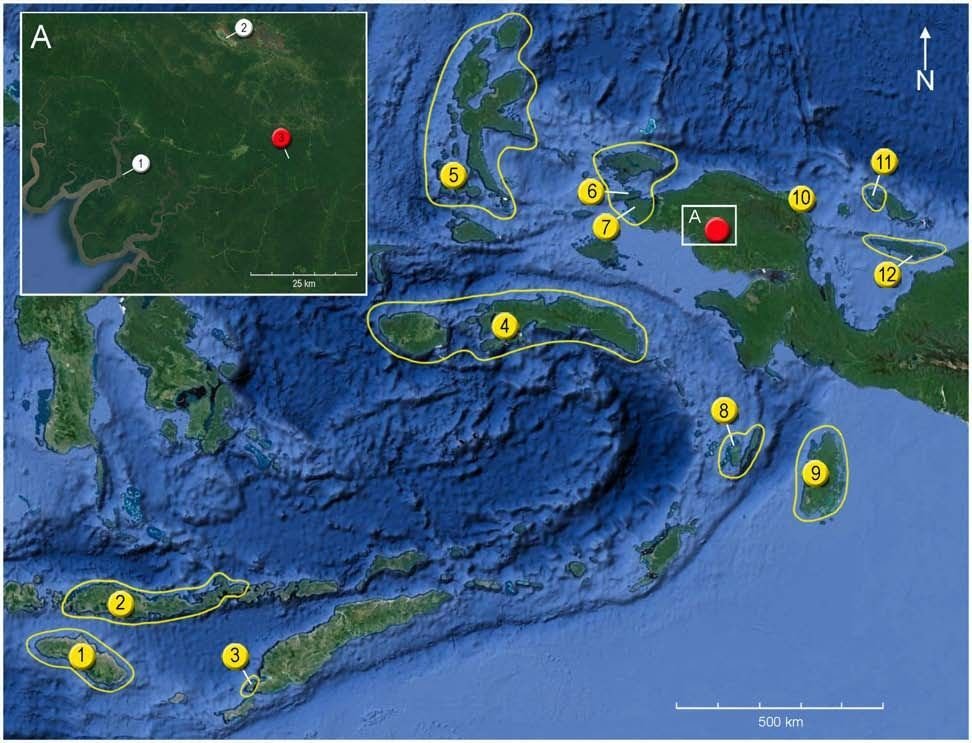
Nine years later, in March 1962, Riet Knaap-van Meeuwen, a researcher at the museum, identified the snake as Stegonotus batjanensis, a groundsnake from the northern Maluku Islands, more than 500 kilometres away across the sea. Then it went back on the shelf with the tag 31199 tied around its neck.
That is where we met it, while I was working on my doctoral thesis about these snakes. It turned out to be a species nobody had named.
Snakes that all look alike
Stegonotus are the Indo-Papuan groundsnakes. They are glossy, mostly brown or grey, not considered venomous, and they live from Borneo and the Philippines to New Guinea, the islands of Melanesia and northern Australia. Most of them look very much alike. That is exactly the problem.
For 150 years, the names given to these snakes were often vague or simply wrong, because there was too little information to do better. When my husband Hinrich, our colleague Mark O'Shea and I went through the collections, we found hundreds of Stegonotus in museums that had no species name, or the wrong one. In 2018 we published a long history of the genus, sorting out which old names belonged to which snakes. With that done, we could finally ask of each unplaced specimen: does it fit any of these names at all?
The snake from Komara did not.
Finding Komara
Before you describe a species, you need to know where it lives. That sounds simple. It was not. There is no "Komara" on modern maps of West Papua.
We tracked down the map the missionaries would most likely have used in the 1950s, a 1942 army map of the area. It shows a village called Komara. A map published in 1968 shows the same village with a school, a very likely place for a missionary family to live, and Mieneke Marcus-van den Nieuwenhuizen's own written account of their years there fits the location. Today the village is called Kamro. It sits in lowland rainforest at about 140 metres above sea level, in the south-central part of the Bird's Head Peninsula, the part of New Guinea that on a map looks like the head of a bird.
We were never able to work out where "apan bebach" was. It seems to be a local name for a particular spot, known to the people who lived there.
Counting scales
How do you tell one brown snake from another? You count.
A snake's belly is covered by a single row of wide scales, like the rungs of a ladder. Scientists call them ventrals. Under the tail the scales continue in a double row, the subcaudals. The numbers do not change as the snake grows, and each species has its own typical range.
We compared our snake with 15 males of S. batjanensis. Their ventral counts ranged from 221 to 236. Our snake had 181. Under the tail they had 78 to 89 subcaudals. Ours had 105. A snake with fewer belly scales and more tail scales is a snake with a relatively longer tail. In the Komara snake, 37 percent of all the scales on its underside lie under the tail. That is the highest proportion in the whole genus.
Three lip scales and one eye
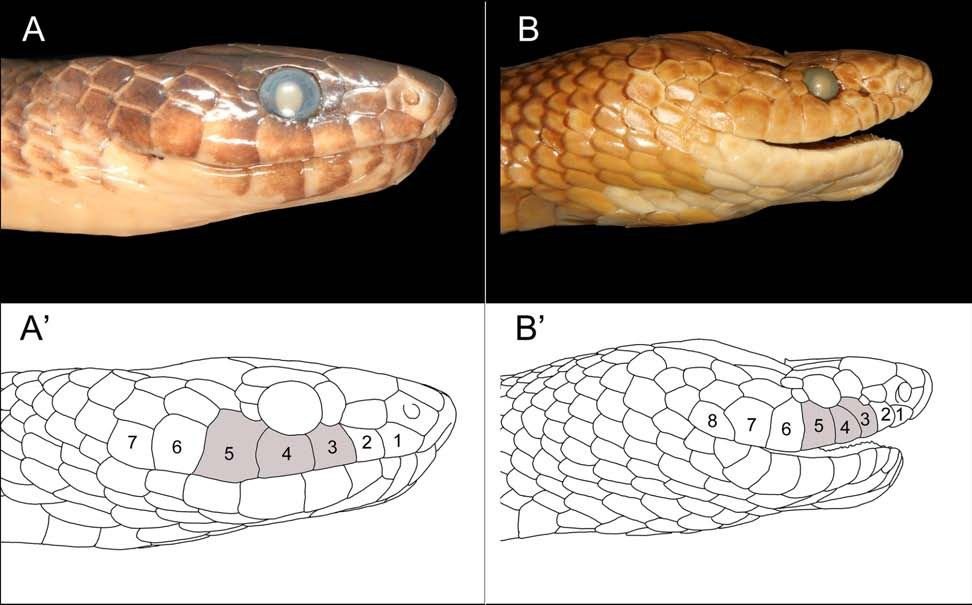
The most telling clue was on the snake's face. Along the upper lip runs a row of scales called supralabials. In most groundsnakes, two of these lip scales touch the eye. In a few species, three do. This is probably why the snake was called batjanensis in 1962: both have three lip scales, the third, fourth and fifth, touching the eye.
When we looked closely, though, the arrangement was different. In batjanensis, the third scale reaches backward to make a narrow contact with the eye. In the Komara snake it is the fifth scale that reaches forward from behind the eye. No other groundsnake does that.
Why one snake can be enough
We had exactly one specimen, an adult male. Can you name a species from a single snake? Yes, if the differences are the kind that do not wobble from one individual to the next.
Some features vary a lot within a species. The total number of lip scales, for example, can differ between two snakes of the same species, or even between the left and right side of one head. But in all the hundreds of groundsnakes we examined, we never saw a species in which some individuals had two lip scales touching the eye and others had three. That number is a strong signal. Add ventral and subcaudal counts that fall far outside the range of the look-alike species, and an eye contact that exists in no other groundsnake, and the case is clear.
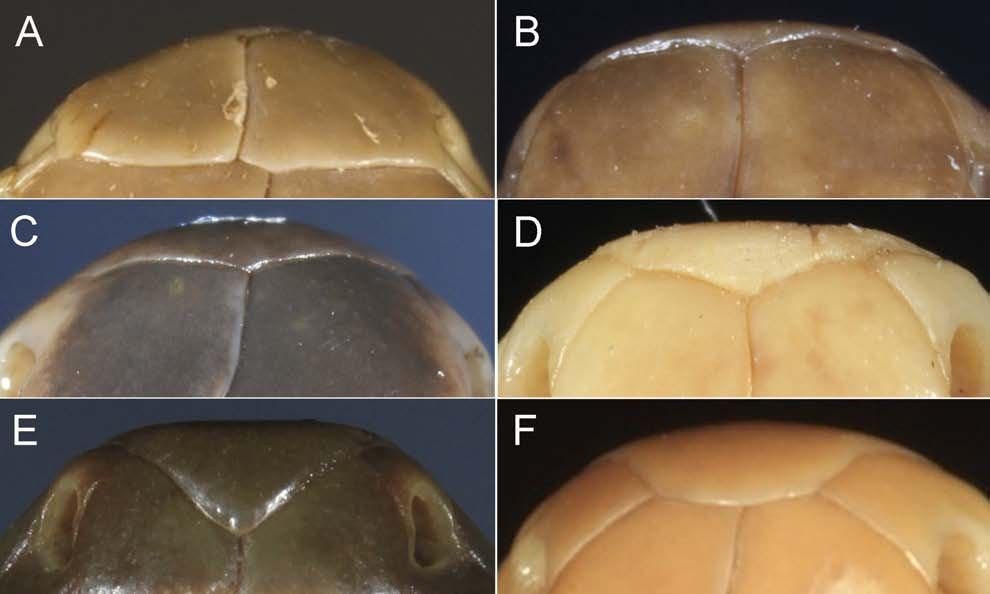
Some of the clues were new. Looking at head photographs again and again, we noticed that the tip of the snout scale (the rostral) shows on top of the head in different shapes. We sorted these into six types with names like "gull wing" and "deep V". We also measured a few angles where head scales meet, using a digital angle finder on the photographs, and a line across the head at the front of the eyes. Several of these turned out to help tell species apart.
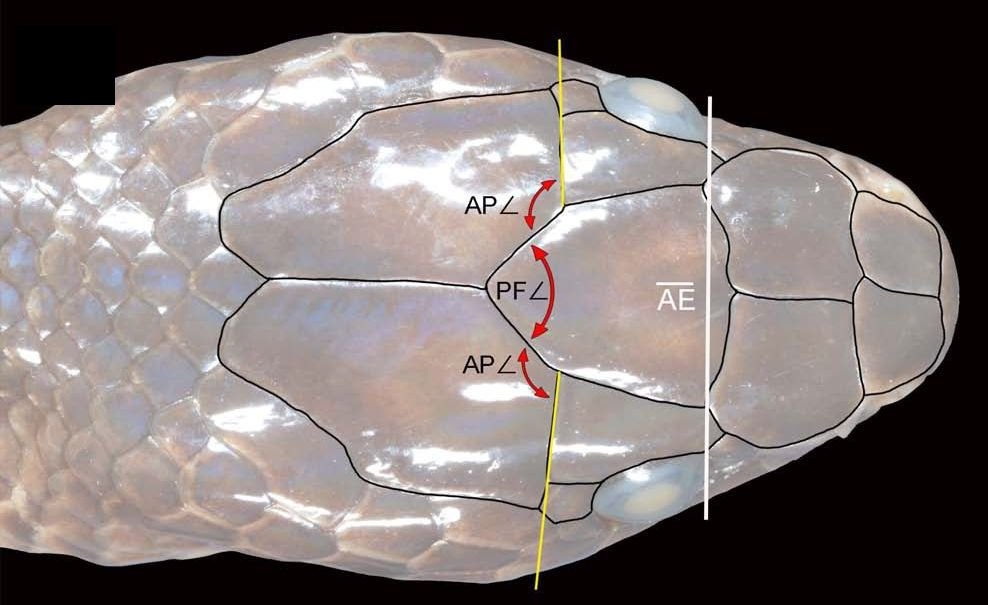
Why not simply use DNA? For almost all of these old museum snakes, there are no tissue samples to work with. We wanted a method that would work on specimens like this one, and that a biologist could also use in the field.
To check ourselves, we also looked at 32 other groundsnakes collected in roughly the same area of the Bird's Head. None of them had three lip scales touching the eye. They were not the Komara snake either, and we think they belong to two more unnamed species. Groundsnakes that look nearly identical can live side by side.
A name with a message
We named the species Stegonotus ayamaru, the Ayamaru groundsnake. Kamro is a village of the Ayamaru people, and Ayamaru is also the name of their language.
The nearby Ayamaru Lakes are home to a shimmering rainbowfish, Melanotaenia boesemani, which became so popular with fish breeders that it was over-collected and is now listed as Endangered. The area around Kamro still has little development, a small population and at least 15 species of birds-of-paradise. West Papua was recently declared a conservation province, and we hope a named snake adds one more reason to keep these forests standing.
"Its initial misidentification serves as a reminder of the continued relevance and importance of natural history collections as repositories for specimens and data that influence our knowledge today by reaching out from the past." — Kaiser et al. 2019
This paper was part of my doctorate at Philipps-Universität Marburg. I remain grateful to George Zug at the Smithsonian, who showed me, in word and deed, how to properly determine the sex of a preserved snake. It is a small skill, but in a group where males and females can have different scale counts, everything depends on it.
The genus keeps growing. In 2021 Mark O'Shea and Stephen Richards described a striking cream-and-black species from southern Papua New Guinea, Stegonotus aplini, with a key for identifying all the New Guinea groundsnakes. Hinrich and I read their draft before it was published, and I commented on an early version of the key.