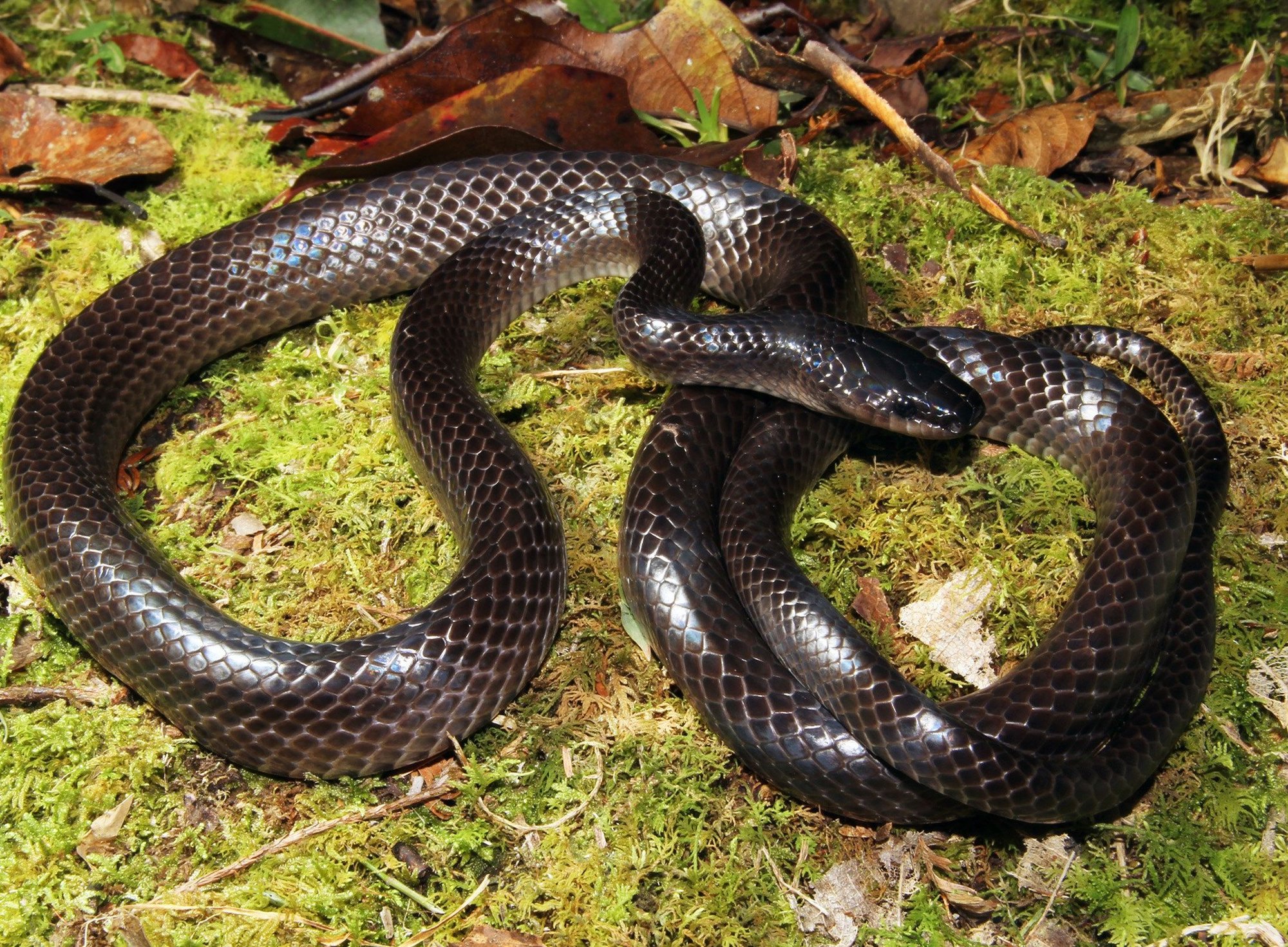
The Dark Head of Kinabalu
Photo: Tom Charlton, from Kaiser et al. 2020, Zootaxa
On 19 January 1993, near a telecommunications tower high in the Crocker Range of Sabah, in northern Borneo, the American herpetologist Robert F. Inger collected a large brown snake. It was a female, over a metre and a quarter long, found at about 1950 metres above sea level. It went into the collection of the Field Museum in Chicago, where Inger had been curator of amphibians and reptiles since 1954.
Twenty-six years earlier, in 1967, Inger himself had described the only groundsnake known from Borneo, Stegonotus borneensis. What he could not have known was that the snake he caught in 1993 would one day show that Borneo has two.
Five snakes on an island
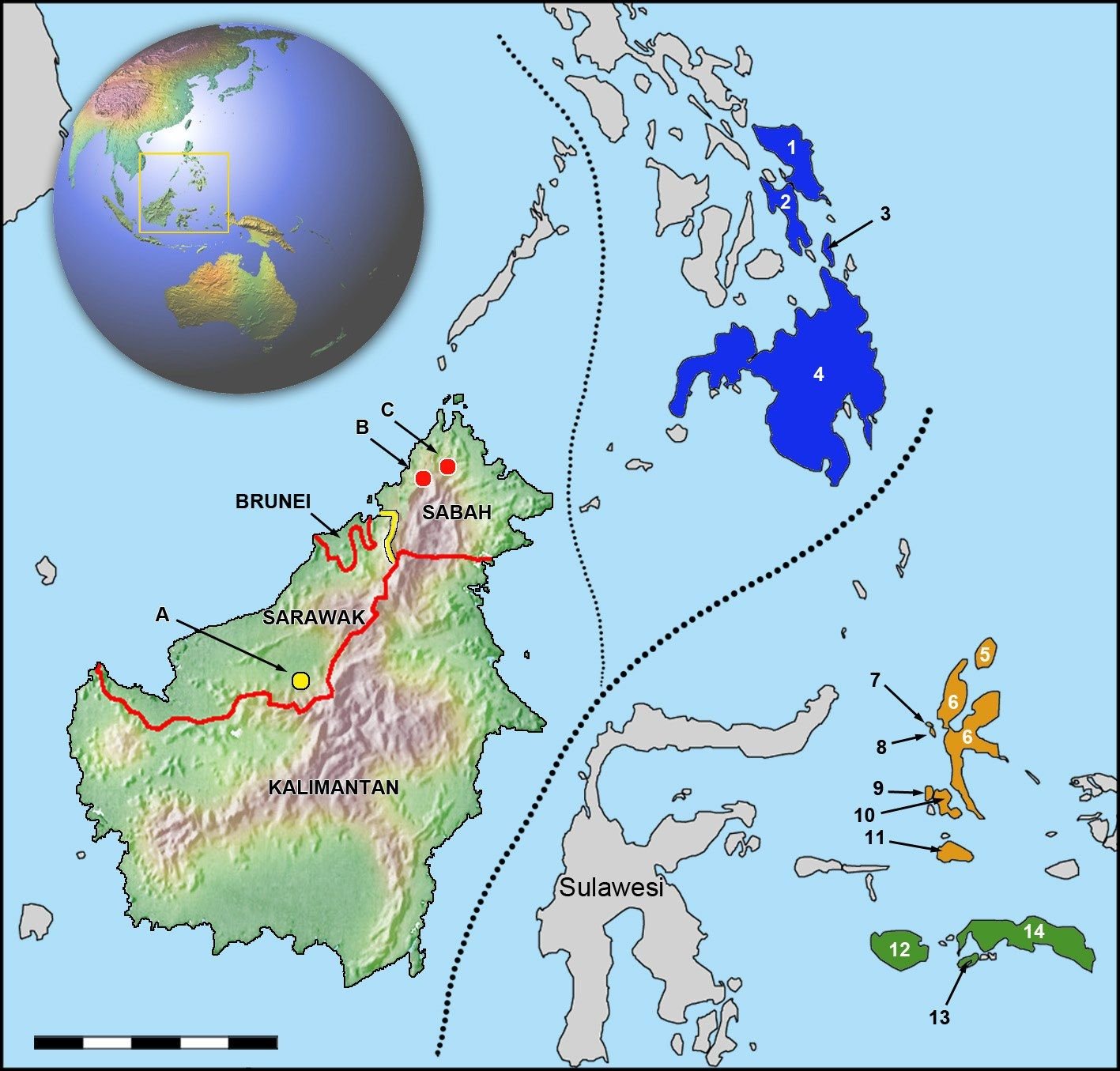
Groundsnakes, genus Stegonotus, are mostly a New Guinea affair. Borneo lies at the far western edge of their range, on the Asian side of Wallace's Line, the invisible boundary that separates the animals of Asia from those of Australia and New Guinea. The Bornean snakes live more than 500 kilometres from any of their relatives.
Inger based his 1967 description on just two specimens. One came from the lowlands of Sarawak, the other from the slopes of Mount Kinabalu in Sabah, 560 kilometres away. He noticed that the scales along the middle of their backs looked different, but at the time nobody knew how much groundsnakes could vary within a species. Naming a single species for the island was the careful choice.
During our revision of the genus we tracked down more than 90 percent of all known Stegonotus in the world's museums. For Borneo, that meant five snakes. Two came from the Sarawak lowlands, including Inger's original. Three came from the mountains of Sabah. When we laid out their numbers side by side, the three mountain snakes were clearly something else.
What the scales said
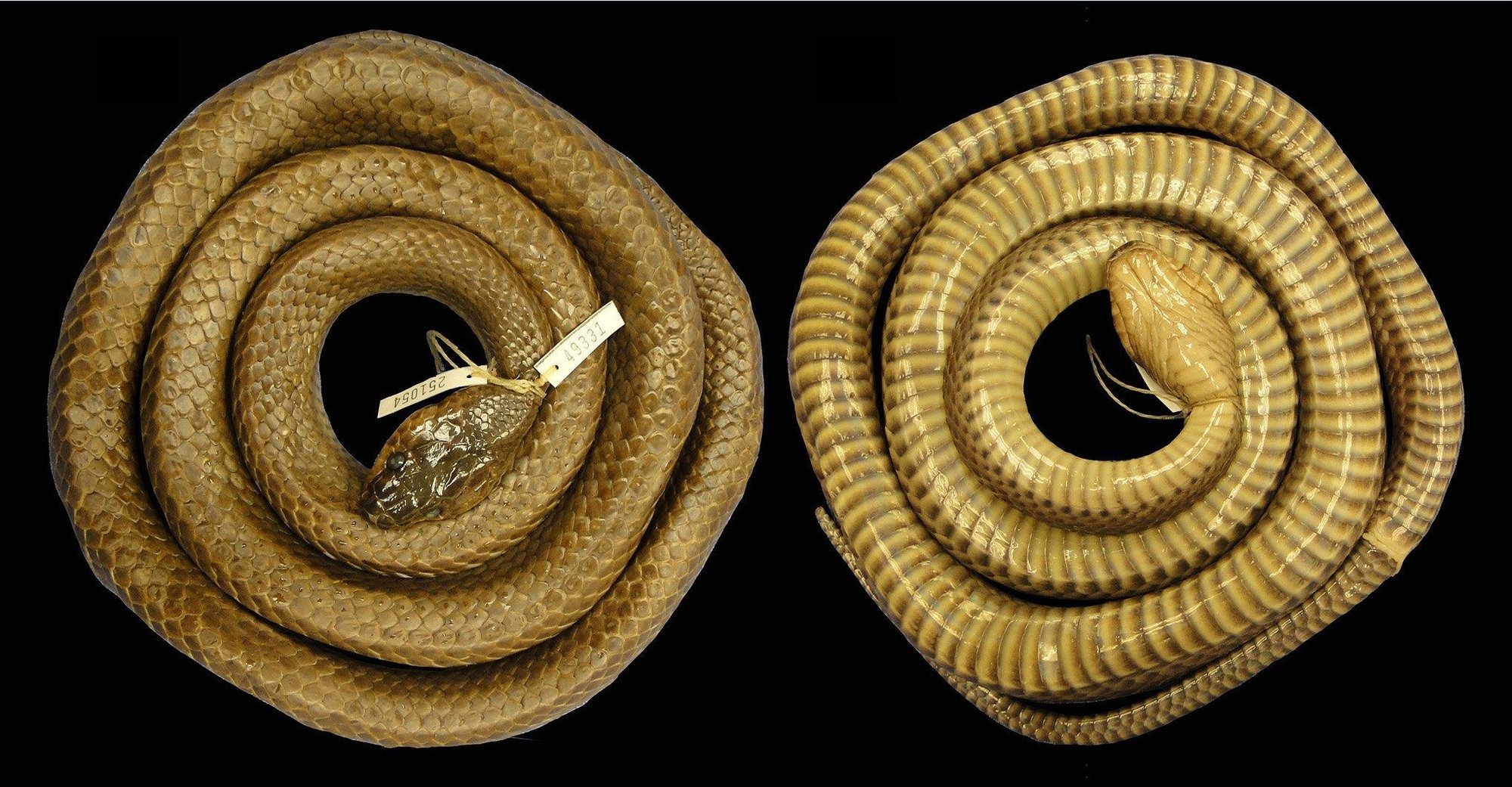
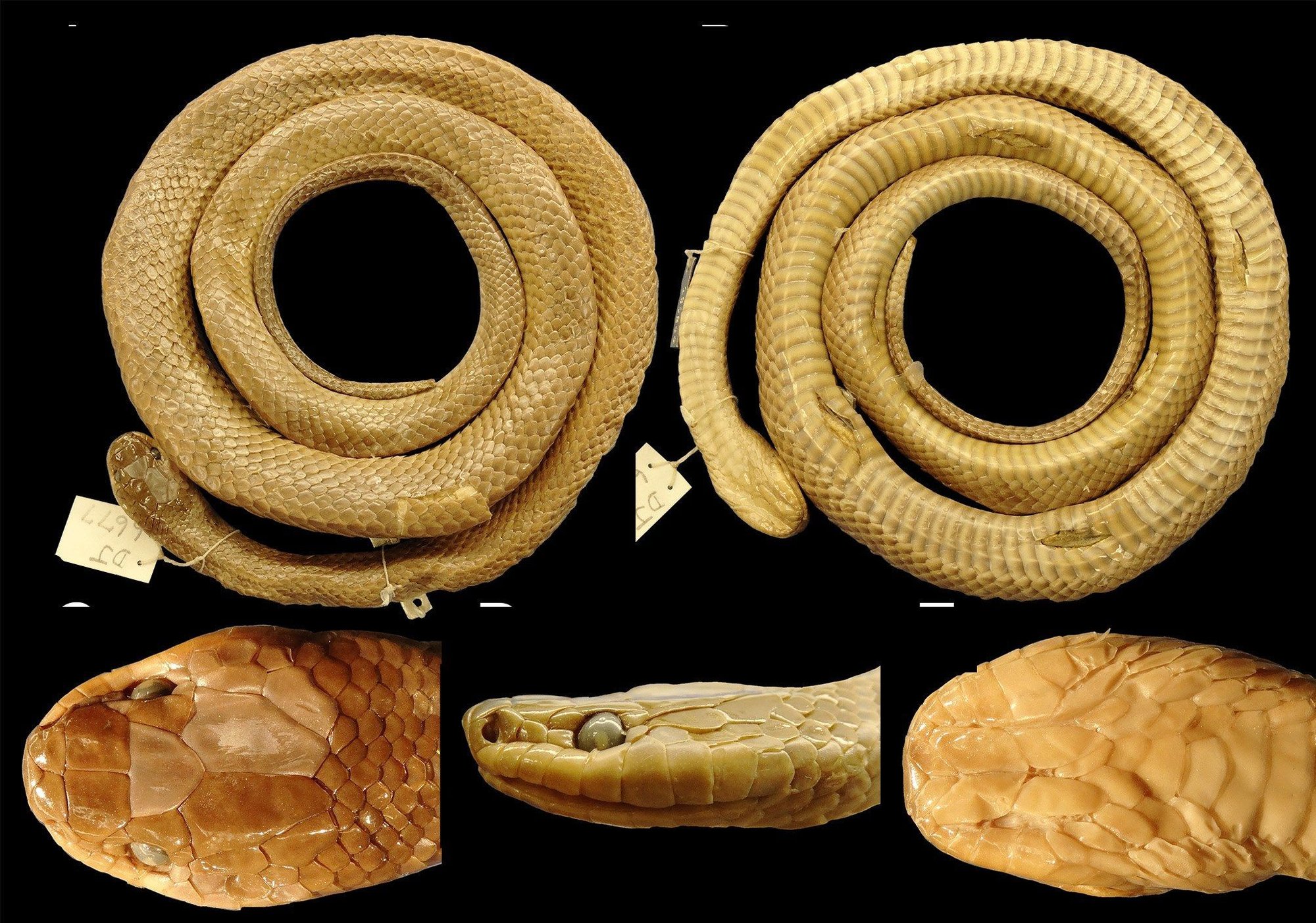
The clearest difference was on the belly. Snakes have a row of broad belly scales called ventrals, and a double row under the tail called subcaudals. The mountain snakes had 211 to 218 belly scales. The lowland snakes had 193 and 196. Under the tail, the mountain snakes had only 56 to 65 subcaudals, while the lowland snakes had 78.
Those numbers describe the shape of the animal. The mountain snakes have long bodies and very short tails: in Inger's 1993 snake, only about one in five of the scales on its underside lies under the tail. That is the shortest tail, by this measure, of any groundsnake. (The Ayamaru groundsnake from New Guinea, which we had described the year before, holds the opposite record.) With so few specimens, we also ran statistical tests, and the differences in belly and tail counts were statistically significant.
There were other clues. The snout scales differ in their proportions, and the mountain snakes have a dark grey-brown head that stands out against a lighter brown body, while the lowland snakes are uniformly dark. And they live in different worlds. S. borneensis is a lowland rainforest snake, known from about 56 metres above sea level. The mountain species has only been found above 1300 metres, in cool montane oak and conifer forest in the Crocker Range and around Mount Kinabalu, the tallest mountain in Southeast Asia.
One snake, two titles
A holotype is the single specimen that anchors a species name. When scientists want to know what a name really means, they go back to that one animal. Paratypes are the other specimens listed with the original description.
We chose Inger's 1993 snake as the holotype of the new species. The paratype we chose has an unusual history. It is a female collected on 1 August 1951 at Bundu Tuhan, on Mount Kinabalu, by David H. Johnson, a mammal curator at the Smithsonian. Inger had used this very snake as a paratype of S. borneensis in 1967. Under the rules of zoological naming, it keeps that original status. So one preserved snake in Washington, DC is now a paratype of two different species.
Never met in the wild
In several trips to the Kinabalu area, we have never seen this snake alive. Everything we know about the living animal comes from other people's field notes, the published literature, and photographs. It seems to be active mainly at night. One observer saw it try to catch a gecko, and there is some disagreement about whether it climbs.
To describe its colours in life, we relied on the photographs of Tom Charlton and Maximilian Dehling, who met these snakes at night on the slopes of Mount Kinabalu above 1300 metres. In their pictures, the dark head stands out clearly against the lighter body.
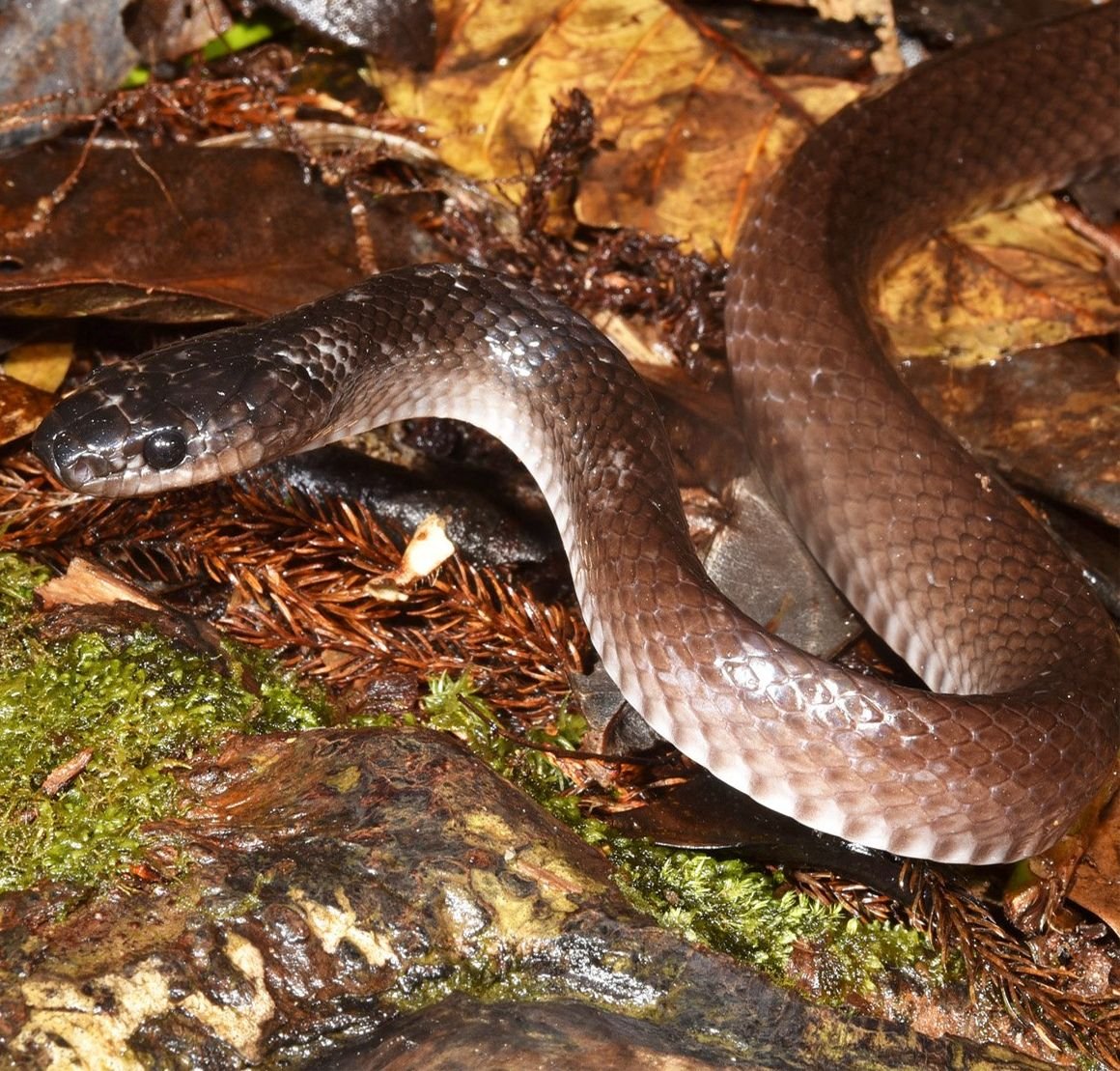
A name for a dark, looming head
We named the species Stegonotus caligocephalus, the Dark-headed Sabah Groundsnake. The name combines the Latin caligo (darkness, fog, or something out of sight) with the Greek kephalos, head. We mixed the two languages on purpose, because the name has two meanings. It describes the snake's dark head. It also describes its home: Mount Kinabalu, a dark, looming, head-like massif. We wanted to remind people that mountains are wonderful places to explore, and to protect.
We are fortunate that the snake still lives inside two protected areas, Crocker Range National Park and Kinabalu National Park, and that people still see and photograph it. In a region where much forest has been cleared for plantations, these parks matter. We hope that a snake found nowhere else will add to their value.
The three snakes we used had been in museums for decades, one of them since 1951, and the population has been known, without a name of its own, since at least the 1880s. Many of the species still waiting to be described are not out in the forest. They are already on museum shelves, waiting for someone to look closely.
I wrote this paper with Hinrich, Mark O'Shea and Jack Lapin of the University of Kansas, who had also examined and photographed the Kansas collection's groundsnakes from the Philippines for our earlier work. Robert Inger died in 2019, a year before the new species was published.