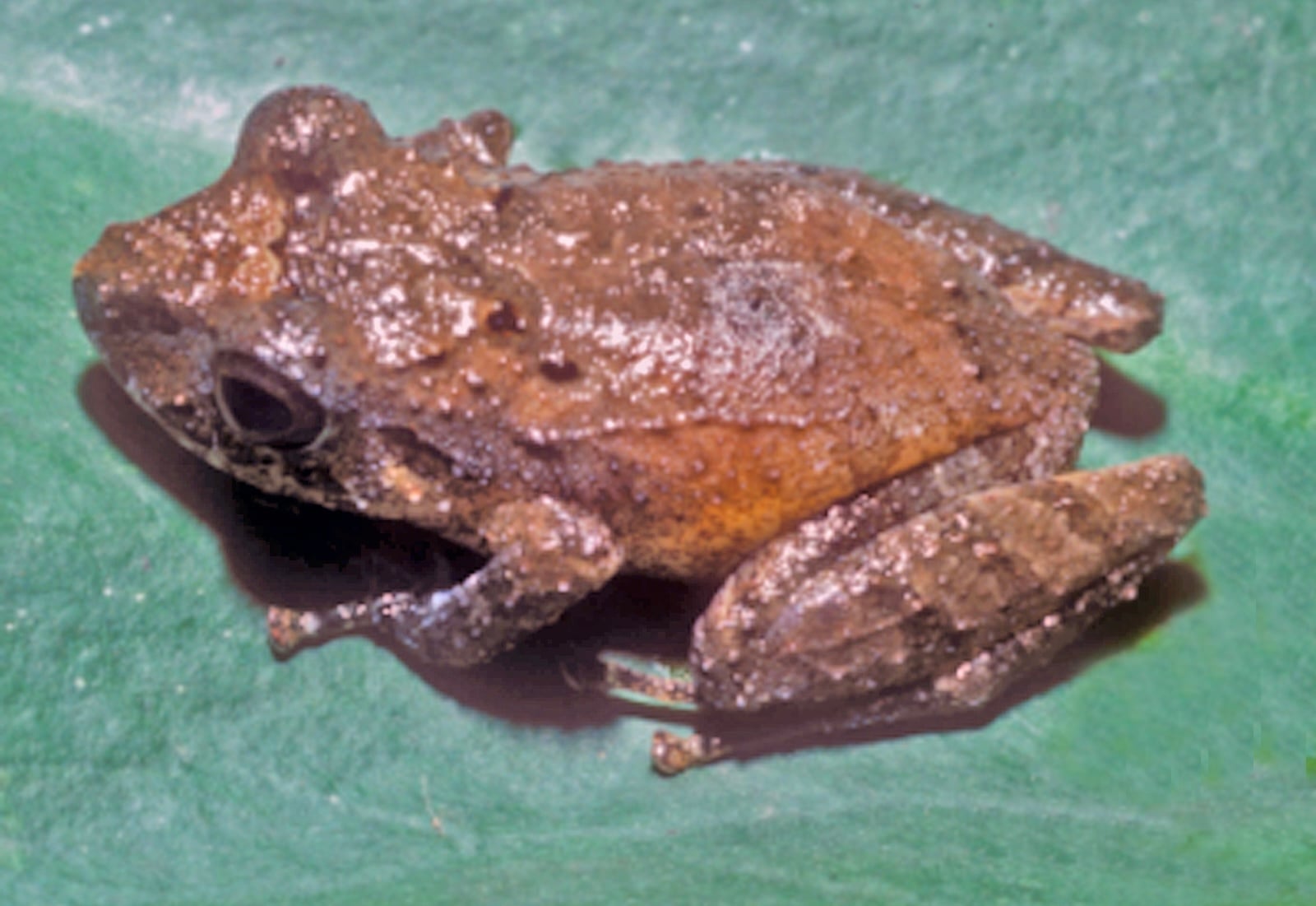
A Frog Named for a Furrow
Photo: University of Kansas Biodiversity Institute, CC BY 4.0, via Wikimedia Commons
If you send me an email, you are writing to a frog.
My address begins with lirellus, the name of the first species I described on my own. It is a small brown frog from the forested foothills of the Andes in northern Perú. Its name is a small picture in Latin: a low ridge of earth, the kind a plough leaves behind in a field.
A frog in a jar
I never met this frog in its forest. In February 1989 a field party from the University of Kansas, working under the frog expert William E. Duellman, collected in the Departamento San Martín in north-central Perú, in the drainage of the Río Mayo. Among their catch were several small frogs of the genus Eleutherodactylus that did not seem to match any named species. They were preserved in the field and brought back to the Natural History Museum in Lawrence, Kansas.
In August 1990 I started my PhD studies at the University of Kansas, in the museum's Division of Herpetology. Bill Duellman made me aware of the new frog and, as I wrote in the paper, deferred its description to me.
The frogs came from three places between 470 and 1200 metres above sea level, on the Atlantic slopes of the Cordillera Oriental, where ridges run down from the Andes into the Amazon Basin. They had been found at night, sitting on low plants beside narrow streams, 3 to 5 metres wide, that run through deep, forested gorges.
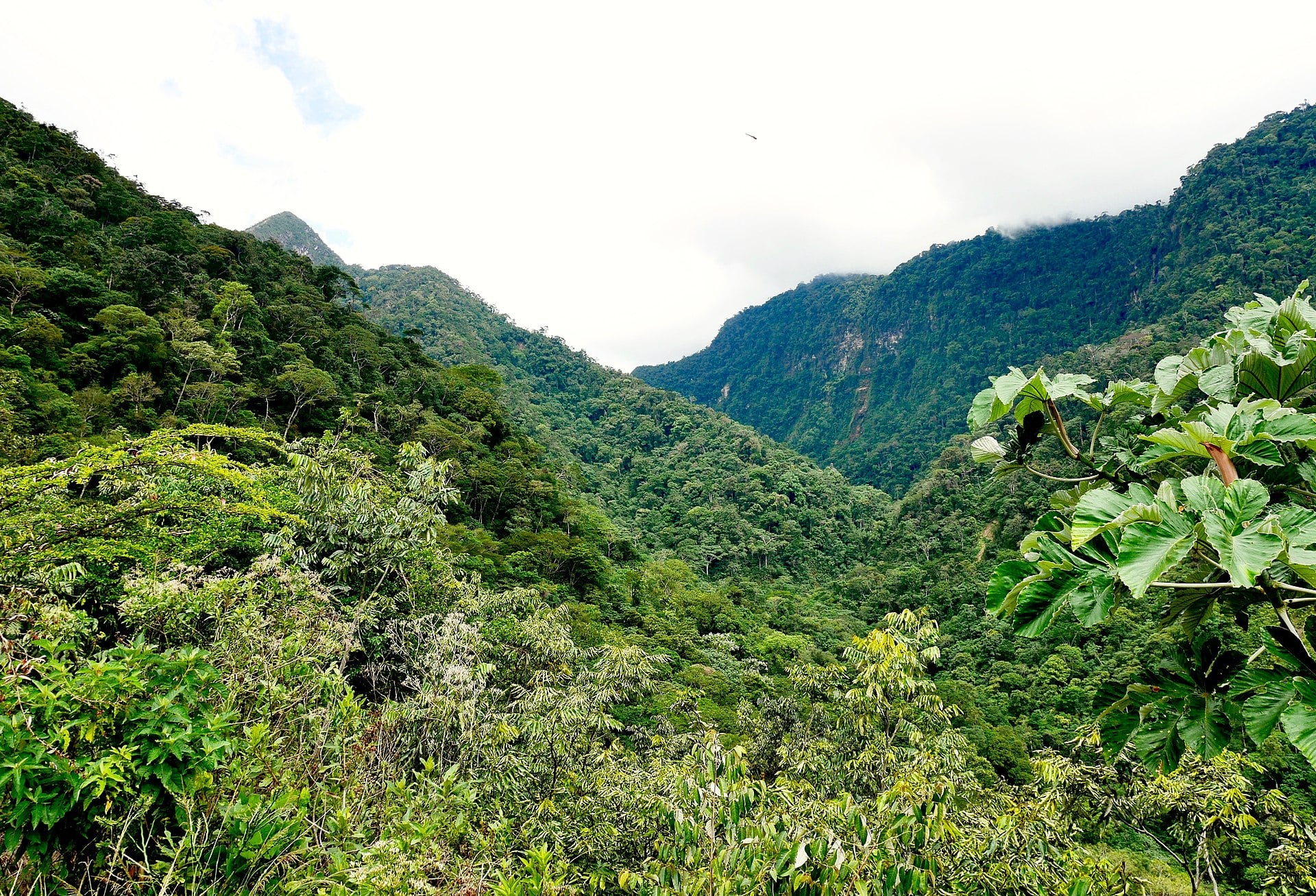
Every species has a holotype: the single specimen that officially carries its name, so that anyone in the future can check what the name really means. For my frog it is KU 212240, a female full of eggs, 23.7 mm from snout to vent, caught by Duellman on 5 February 1989 on the western slope of Abra Tangarana, a mountain pass at 1080 m.
When the colours fade
Small brown frogs are notoriously hard to tell apart, and this one had five look-alikes in the upper Amazon Basin. All six species have bright yellow or orange patches in the groin. These "flash colours" are tucked away when a frog sits still and show when it stretches its hind legs. In life the colour and shape of these spots make the species fairly easy to separate.
In a museum jar they are not. In preservative the colours fade quickly. My frog's pale yellow or orange-yellow groin spots turn cream, or simply see-through. Everything I knew about its living colours came from Duellman's field notes and his colour slides.
So I measured instead. With dial calipers and a dissecting microscope I took measurements to the nearest tenth of a millimetre on 37 specimens of the new frog and 166 specimens of its five look-alikes from the Kansas collection. Then I used a statistical method called discriminant analysis. It looks for the combination of measurements that best separates groups, and then checks how often each frog would be sorted into the right one.
Only three measurements were needed: body length, head width and the length of the shin. On average the analysis placed the new species in its own group 86.7% of the time, more often than any of the other five. In the paper I called the measurements "a welcome and refreshingly unequivocal line of evidence." The same numbers hinted that one of the other species, E. carvalhoi, might really be more than one species hiding under a single name.
Hinrich Kaiser, today my husband, helped me with the statistics and read the manuscript critically. I thanked him for it in the acknowledgements.
What makes it different
Eleutherodactylus lirellus is small even for its group. Adult females measure 19.4 to 24.0 mm, and the three adult males I had were only 14.1 to 17.0 mm, about the length of a fingernail. By day it is dark brown to reddish brown; at night it can be pale tan. Its eardrum is hidden under the skin, its fingers and toes carry narrow fringes along their sides, and each groin has a single pale yellow to orange-yellow spot. Males have a yellow vocal sac, the balloon of skin under the throat that swells when a frog calls. The iris is reddish brown or bronze with a red streak across the middle.
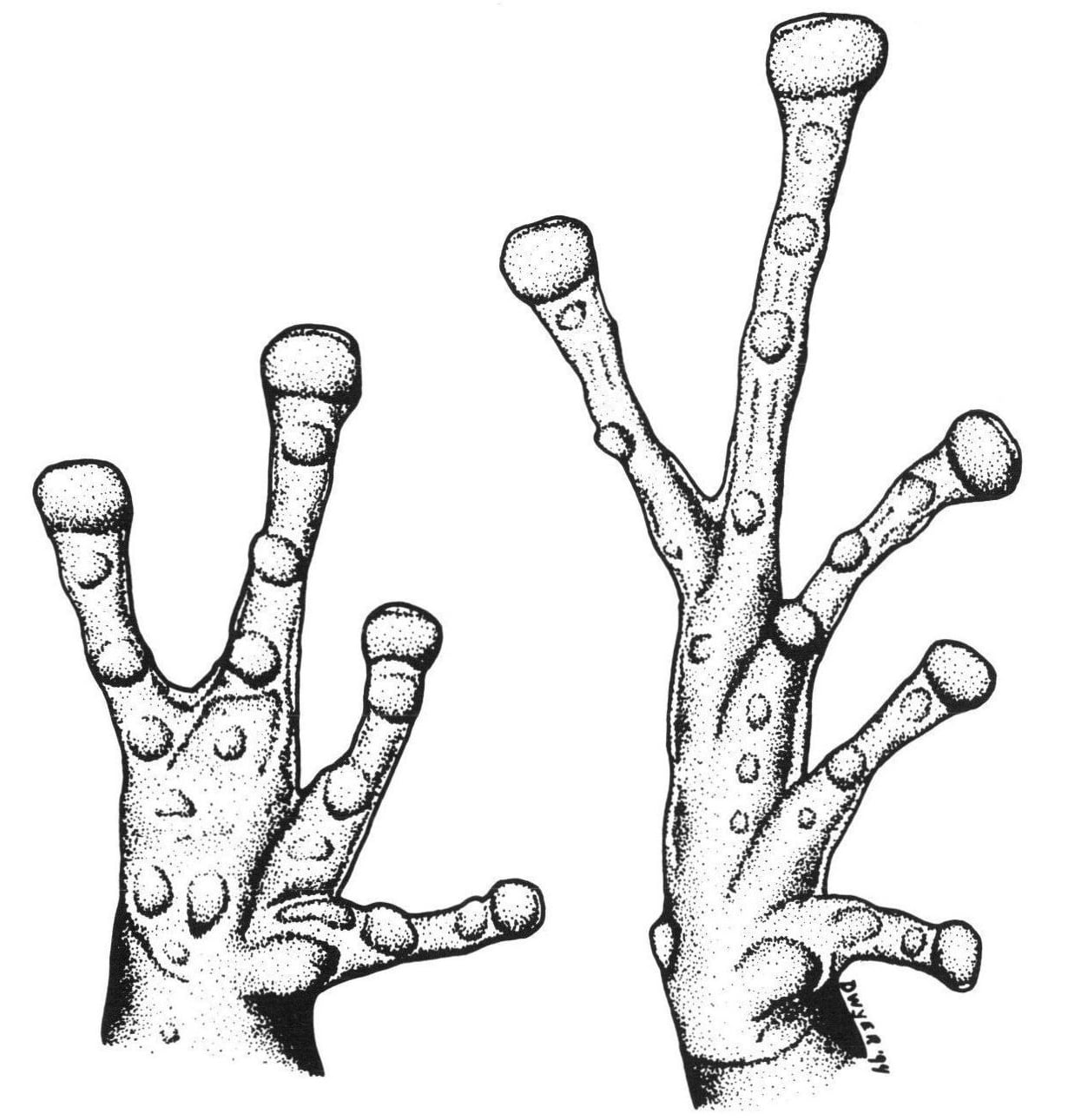
I drew the hand and foot myself, looking through a dissecting microscope with a camera lucida. That is an old optical trick: a small prism lets you see the specimen and your drawing paper at the same time, so you can trace what is under the lens. The drawing is signed "Dwyer '94", my maiden name. Tracing this way puts every tubercle, the small bumps under the fingers and toes, exactly where it sits on the specimen.
The name
The paper was received by the journal Amphibia-Reptilia on 16 August 1994 and accepted on 9 January 1995. The name has changed a little since then. The enormous genus Eleutherodactylus has been split into several genera, and my frog is now called Pristimantis lirellus. The part I chose has stayed the same, and so has my email address: Lirellus@yahoo.com. Hinrich did much the same with a frog of his own, the copper-eyed chalcopis from Martinique.
From Kansas to Würzburg
Most of the work on the specimens was done in Lawrence while I was a graduate student at the museum. There was work closer to home, too: I was one of five authors of a 79-page survey of the amphibians and reptiles of the Fort Riley Military Reservation, published by the Kansas Biological Survey in 1994.

By the time the paper was finished I had moved to Würzburg, Germany. My address on the paper is the Institute of Human Genetics at the university's Biozentrum, where I worked as a technical assistant in chromosome testing. Chromosomes are the packages of DNA inside every cell. Counting them and comparing their shapes is a medical test in people, and in frogs it can help tell one species from another. The institute even paid part of the cost of publishing my frog.

A second frog, from Tobago
That link between frogs and chromosomes produced a second species the same year. The small whistling frogs of the forests on Tobago had always been counted as a Venezuelan species. Near the village of Charlotteville, Wolfgang Feichtinger and Michael Schmid of the Würzburg institute noticed that the frogs they heard sounded wrong for it. Their calls, their body shape and their chromosomes all turned out to be different.
In 1995 Hinrich, Wolfgang, Michael and I described the Tobago frog as Eleutherodactylus charlottevillensis, today Pristimantis charlottevillensis. The title of the paper promised a "morphometric and cytogenetic characterization": measurements, as with my Peruvian frog, plus chromosomes. We named it after Charlotteville, "whose friendly populace has aided herpetologists during their surveys for many decades." It lives nowhere else in the world.
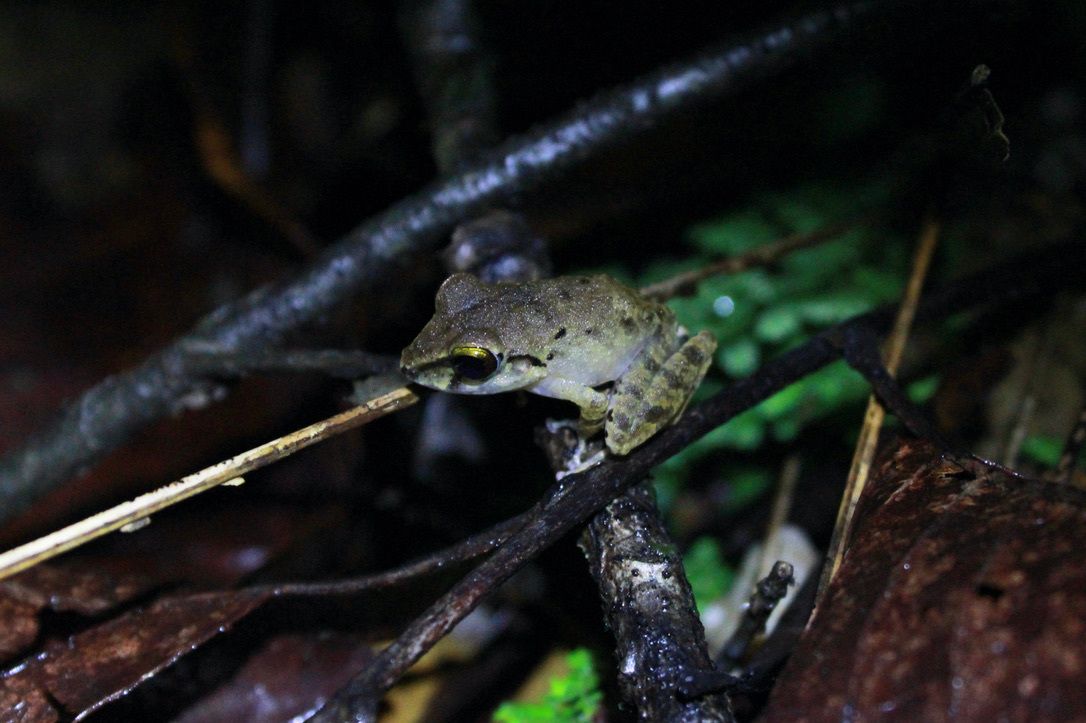
So 1995 was the year I named my first two species: one alone, from a jar in Kansas, and one with three colleagues, from a Caribbean island. It took more than two decades, and a switch from frogs to snakes, before I named the next one.
The papers
- (1994) A survey of the herpetofauna on the Fort Riley Military Reservation, Kansas Kansas Biological Survey Report 58: 1–79
- (1995) A new species of Eleutherodactylus (Anura: Leptodactylidae) from Perú and its morphometric characterization Amphibia-Reptilia 16: 245–256
- (1995) A new species of Eleutherodactylus (Anura: Leptodactylidae) from Tobago, West Indies, and its morphometric and cytogenetic characterization Herpetological Natural History 3: 151–163