Counting Crocodile Newts
Photo: Dung Van Tran, from Tran et al. 2026, Herpetology Notes
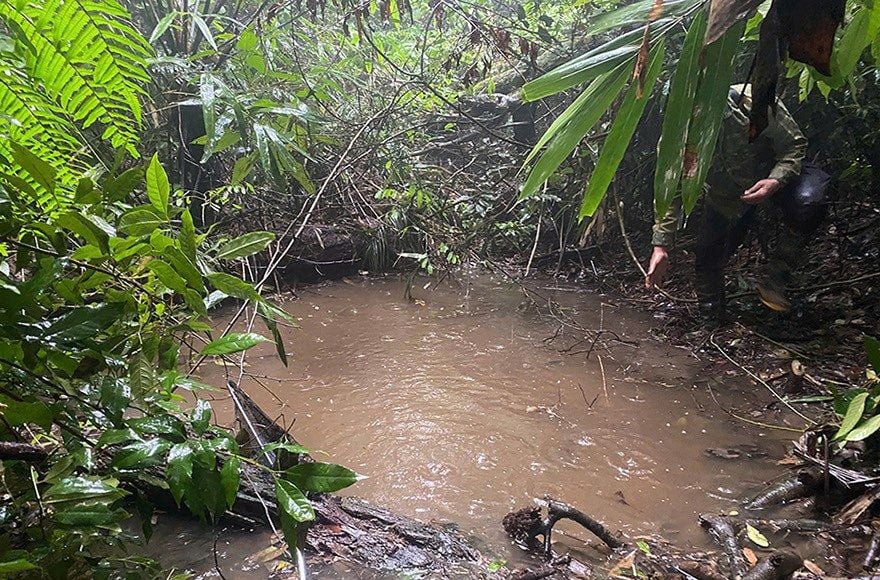
High on Ten Mountain in northern Vietnam, at 1,232 metres, there is a forest pond about two metres across and twenty centimetres deep. It is little more than a muddy puddle under the trees. For three days in the rainy season of 2025 it held 28 Pasmans's crocodile newts. That was nearly every newt of this species that Dung Van Tran and his colleagues could find in the whole of Xuan Son National Park, a protected forest of more than 150 square kilometres.
Nobody had ever counted these newts before. In fact, nobody had ever estimated the population of any newt species in Vietnam. This was the first time.
A newt nobody had counted
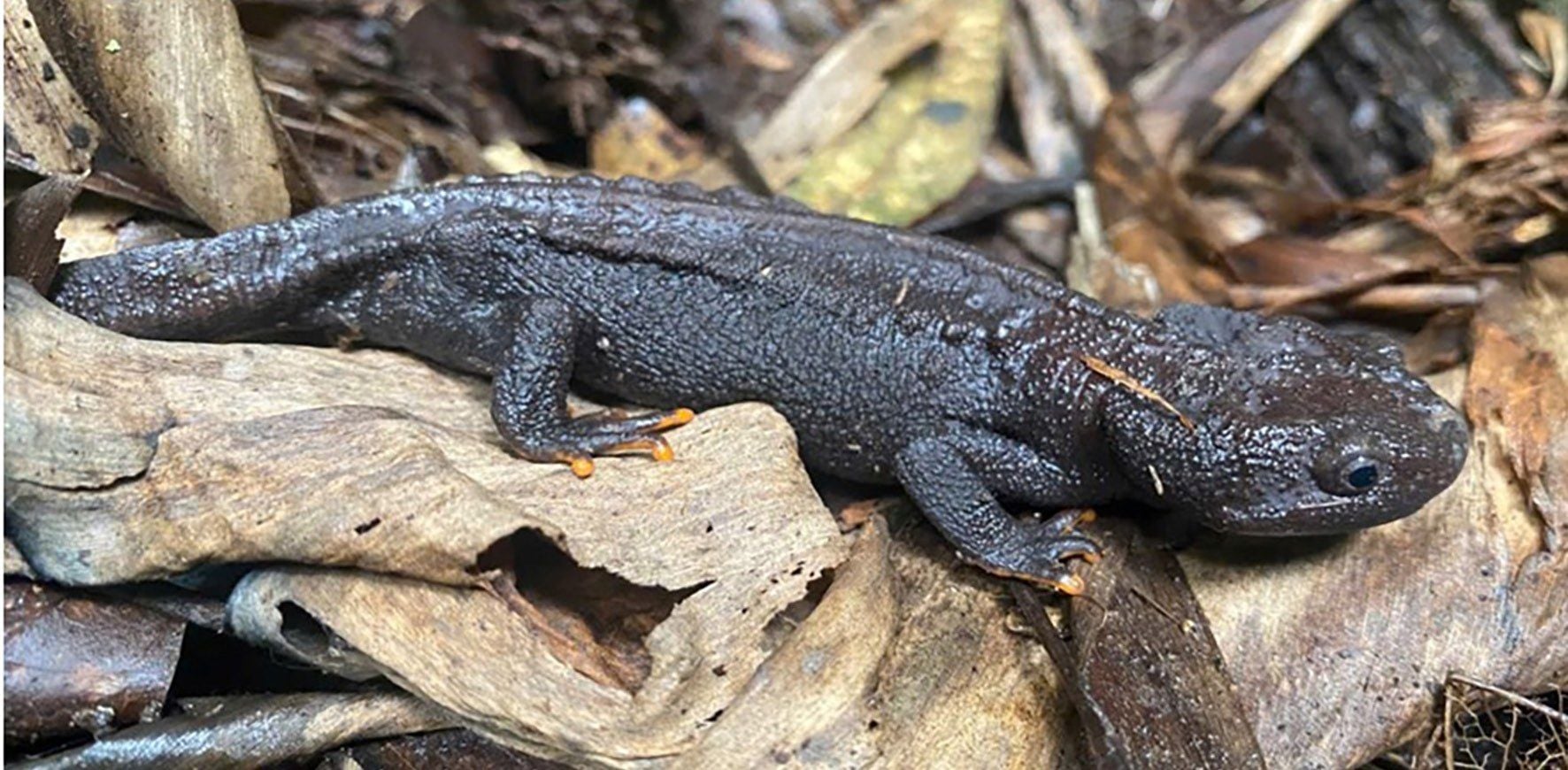
Tylototriton pasmansi, Pasmans's crocodile newt, is a dark, knobbly animal with bright orange fingertips. It was only recognised as a species of its own in 2020. Before that it was treated as a Vietnamese population of a related newt, Tylototriton asperrimus, which is now thought to live only in China. When museum specimens and new collections were re-examined, the Vietnamese animals turned out to be two separate species.
So far, Pasmans's crocodile newt has been confirmed at only a handful of places in Phu Tho, Son La and Thanh Hoa provinces. The whole area over which it is known to occur has been estimated at about 3,780 square kilometres. Within it, forests are being cleared for farmland and stripped of forest products, and that loss of habitat is the most serious threat the newt faces.
Asking the neighbours first
The fieldwork was done by a team from the Vietnam National University of Forestry: Dung Van Tran, Linh Thao Nguyen, Phuong Thi Thu Nguyen and Vinh Quang Luu. Kanto Nishikawa of Kyoto University and I joined them as co-authors, and I handled the manuscript with the journal as its corresponding author.
The team did not start in the ponds. They started in the villages. People who live next to a forest usually know what lives in it, and a conservation plan only works if the community around it supports it. So the team asked open-ended questions of forest rangers and residents: have you seen newts, where, and what is happening to them?
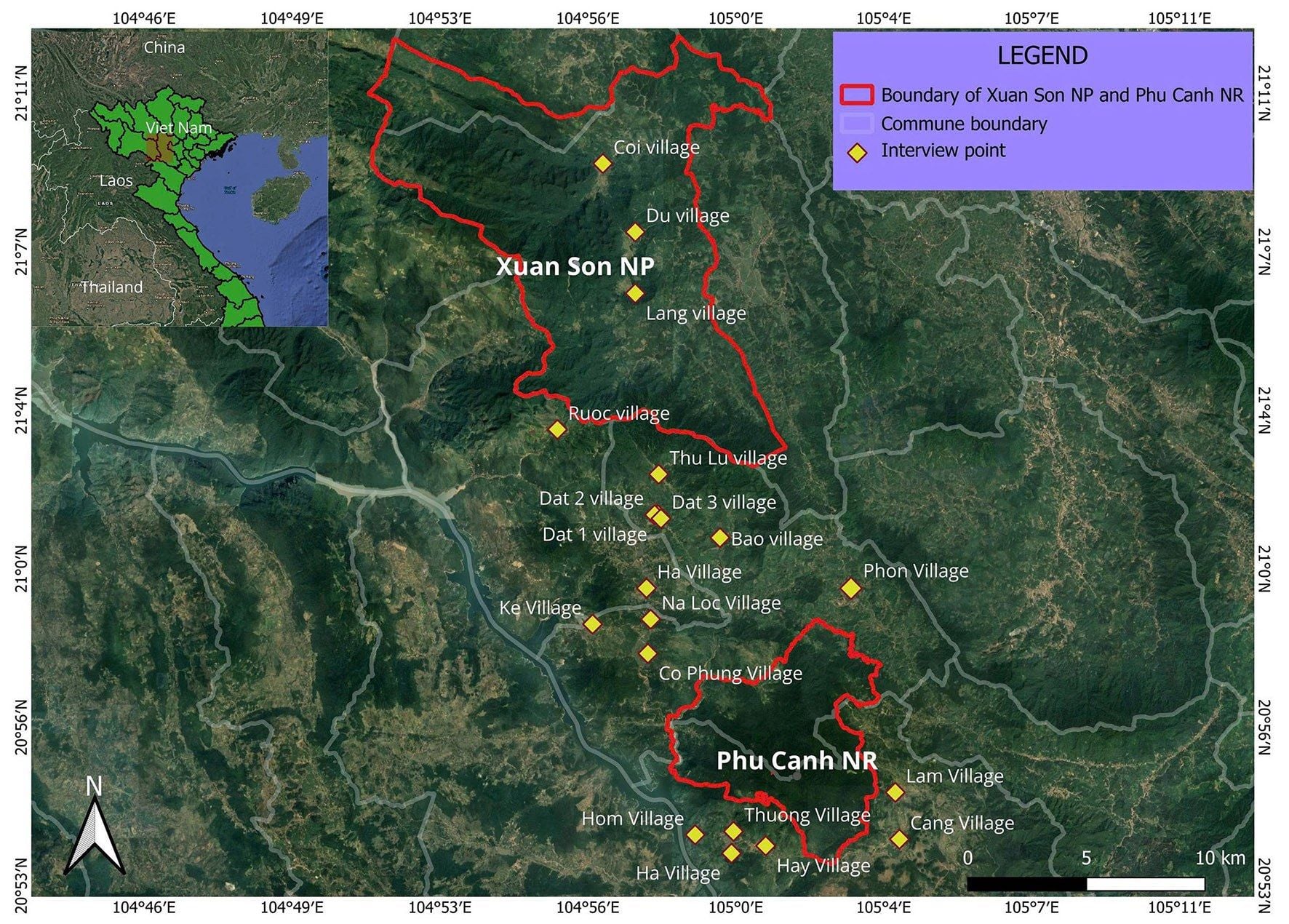
They talked to 105 people in nine hamlets around Xuan Son National Park and 80 people in eleven villages around Phu Canh Nature Reserve, the smaller reserve just to the south. The answers pointed to three mountains: Ten Mountain in Xuan Son, and the Doi Chong and Tham Luong mountains in Phu Canh. That is where the searching began.
Counting by toes
You cannot simply count every newt in a pond. Many hide in the mud or under leaves, and some are away when you visit. Ecologists get around this with a method called capture–mark–recapture.
On the first day, the team caught every newt they could, marked each one and let it go where it was found. On the second day they caught newts again. Some already carried a mark; others were new, and those were marked too. On the third day they did it once more. The proportion of marked to unmarked animals in each catch lets you work out how many newts must exist that were never caught at all. If almost every newt you catch on day three is already marked, you have probably met most of the population.
Each newt was marked by clipping the tips of two toes that are not next to each other, in a combination unique to that animal. The toes were cleaned first, the tips removed with sterile surgical scissors, and the wound treated with antiseptic. Crocodile newts regrow a clipped toe in about two weeks, so the mark does no lasting harm. The team also recorded each newt's sex, the exact spot where it was caught, and details of its pond.
They surveyed five ponds in July and August 2025, two in Xuan Son and three in Phu Canh, all between 997 and 1,232 metres above sea level.
Seventy newts in a national park
In Xuan Son the team recorded 32 adult newts, 15 males and 17 females, and found no eggs or larvae. Twenty-eight of them came from that one small pond on Ten Mountain. In Phu Canh they recorded 112 newts: 73 males, 39 females and three young ones. Seventy-eight of those were in a single pond, where many larvae were also swimming.
From these catches, the statistics gave an estimate of about 70 newts at the Xuan Son ponds and about 236 at the Phu Canh ponds.
Those are small numbers. In Thailand, a similar study of a related crocodile newt, Tylototriton uyenoi, estimated about 360 animals in an area of just 16 hectares. In Laos, the knobby newt Tylototriton podichthys numbered about 301 at a site of under six hectares. Xuan Son National Park covers 15,048 hectares, and the team found Pasmans's crocodile newts in only a few of its ponds. Even a forest that looks healthy, it seems, can only support these newts where the right kind of pond exists.
The newts also taught the team something about themselves. Across both sites, a newt caught once was less likely to be caught again. Biologists call this being "trap-shy". It is also possible that some newts had simply left: adults of pond-breeding newts often visit the water only for a short time to mate and lay eggs. Males tend to arrive early and stay longer, while females leave soon after laying, which may explain why the Phu Canh catch had nearly twice as many males as females. A three-day survey cannot tell these explanations apart, so the team recommends four or five surveys a year.
Life in a puddle
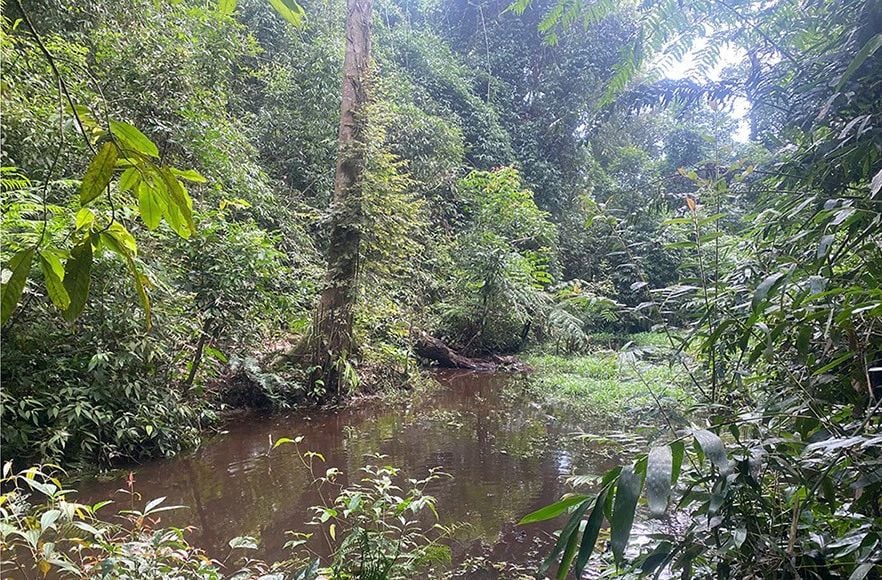
The ponds themselves turned out to be remarkably alike. Every one was small and still, between half a metre and about six metres wide and only ten to thirty centimetres deep, with a muddy bottom. The water stayed between 21 and 25 °C. Its acidity ranged from slightly acidic to alkaline, perhaps because of rotting leaves in some ponds and the limestone rock in others. Tree cover varied enormously, from about a quarter of the sky blocked to almost all of it.
The smallest pond, half a metre wide and ten centimetres deep, still held four newts.
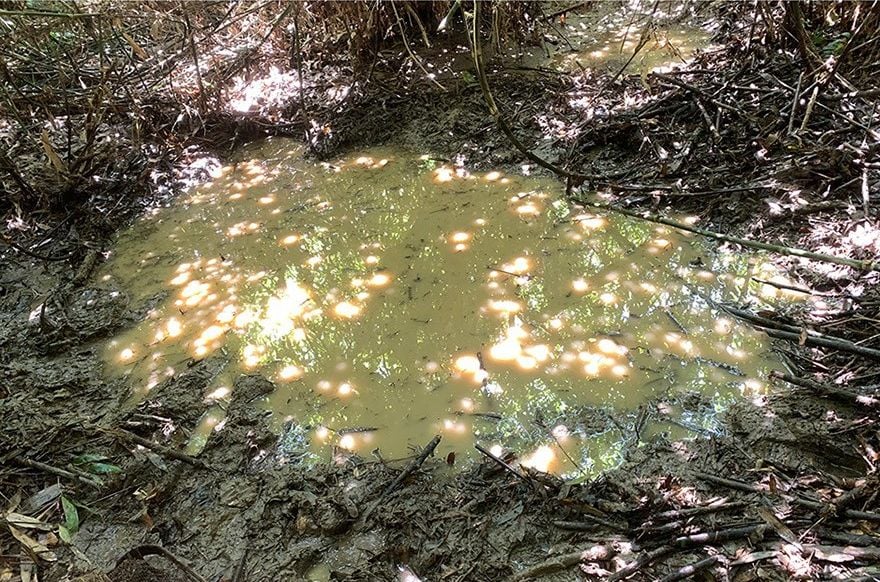
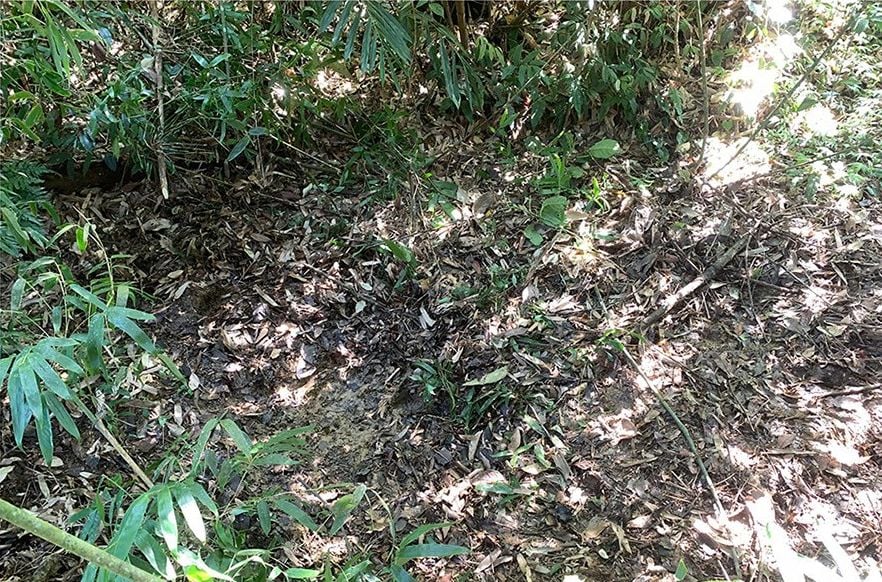
Unlike newts and frogs that breed in streams or big lakes, Pasmans's crocodile newt depends on these little forest pools. That makes it vulnerable. At these elevations such ponds are small and scarce, and a warmer, drier climate could make them dry out before the larvae are ready to leave the water. One pond the team visited had already dried up. There were no newts in it.
What comes next
The team's recommendations are practical. Help natural ponds hold their water. Try building artificial ponds that copy the depth and plants of the real ones, and monitor them carefully. Survey several times a year. And work with the people who live around the forest, since it was their knowledge that led the team to the newts in the first place.
"As climate change intensifies, habitat monitoring and improvements, such as the establishment of breeding pools, along with education of local residents are needed to prevent local extinctions of this interesting species." — Tran et al. 2026
The results also give the IUCN something it did not have before: real numbers. The team suggests that the newt's Data Deficient status be revisited once similar data come in from the rest of its range. The fieldwork was supported by the Fonseca Species Conservation Fund.
Seventy newts in one park and 236 in another is not a large number of animals. But it is a number, and for a species that had never been counted, that is where protecting it has to begin.
The papers
- (2026) Population size and microhabitat features of the crocodile newt, Tylototriton pasmansi Bernardes et al., 2020, in northern Vietnam Herpetology Notes 19: 243–251