The Snake with Two Faces
Photo: Smithsonian Institution (National Zoo), via Wikimedia Commons, CC0
On 20 April 2025, villagers in Pu Luong Nature Reserve in northcentral Vietnam cut bamboo poles in the forest near Hang Khoai to use in their home. They carried the bamboo back to a house in Pa Pan Village. Two days later, a slender green snake slid out of one of the stalks. The frightened homeowner killed it.
It would have been easy for that to be the end of the story. Instead, word reached a team of zoologists at Hong Duc University, and a villager, Bui Thi Ha, helped them obtain the snake. It had a horn on its nose. And when they looked closely at its face, they found that its two sides did not agree about what it was.
Snakes with horns
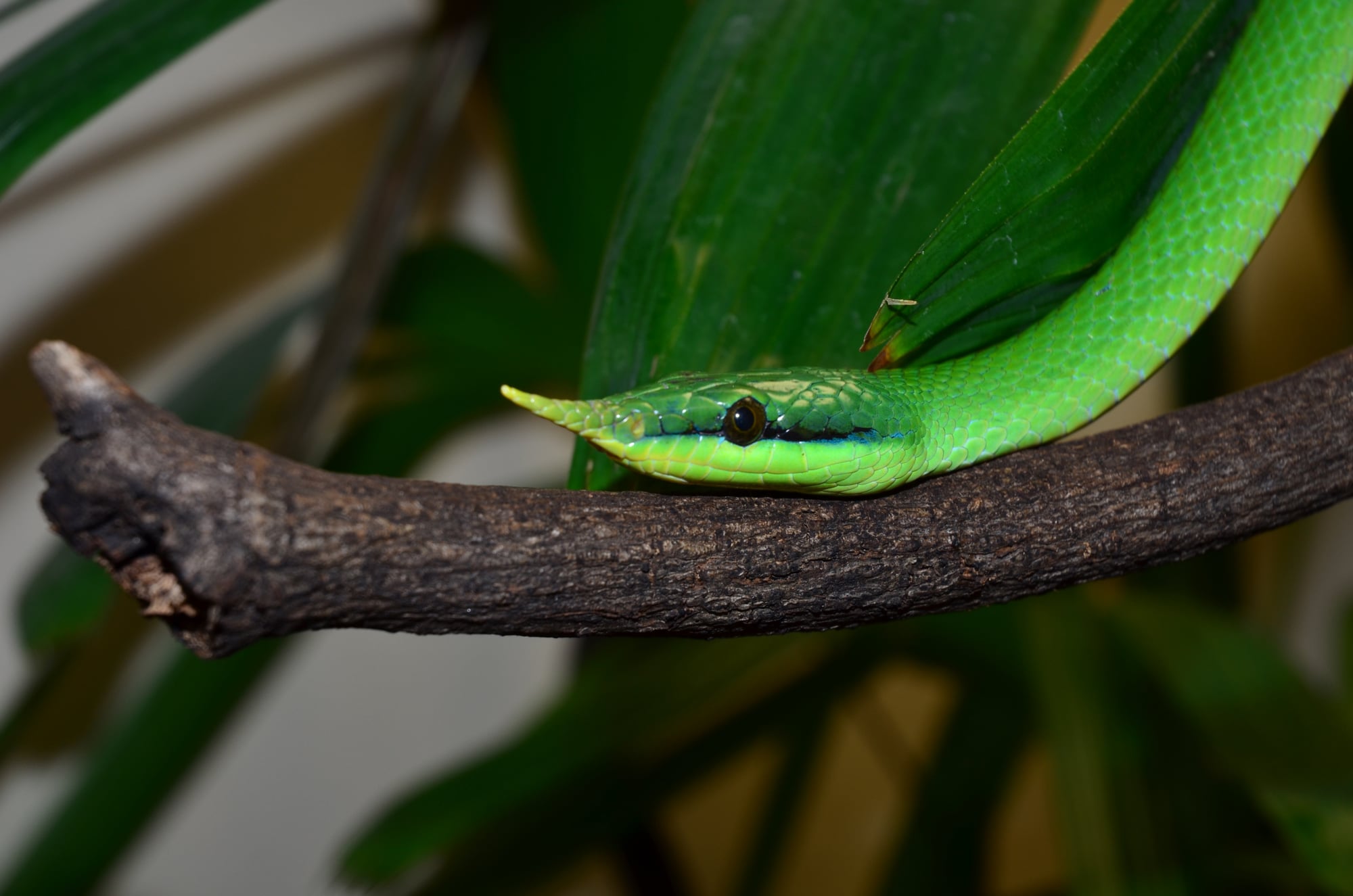
The snake belongs to Gonyosoma, a genus of nine species of green ratsnakes that live in the trees and bushes of Asian forests. Five of them occur in Vietnam. Two have a pointed, scaly projection on the tip of the snout, the feature that gives them their common names: rhinoceros ratsnakes, or long-nosed ratsnakes.
The better known of the two is Gonyosoma boulengeri, described by Mocquard in 1897. It lives in southern China and in at least ten provinces of Vietnam, from sea level up to about 2,000 metres, usually near streams and lakes. Adults are vivid green and can grow longer than a metre. Young snakes eat lizards and fish, and adults move on to rodents. Females lay 2 to 17 eggs and often guard them.
The second species, Gonyosoma hainanense, was described only in 2021, from Hainan Island in southern China. It is said to be slightly smaller, and is known from forest valleys on Hainan at 80 to 900 metres. Until now, it had never been reported anywhere else.
Reading a snake's face
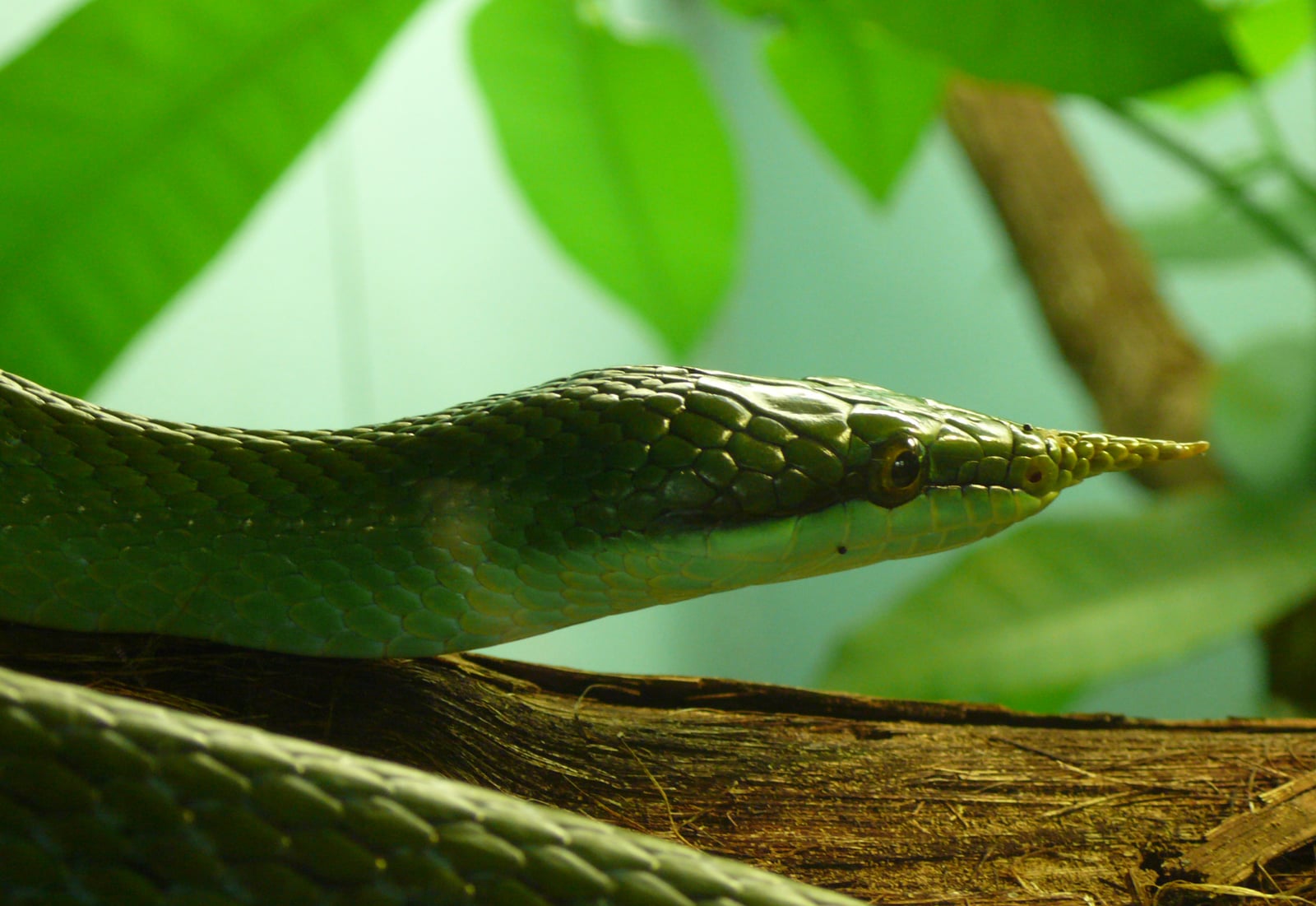
To tell the two species apart, herpetologists look at the small scales on the side of the head. Between the nostril and the eye sits a scale called the loreal.
Gonyosoma boulengeri has a single, long loreal scale on each side. It also has a thin black edge along the lower margins of the scales around the eye and the side of the head, forming a dark line between the green head and the paler lips. The team named this the labial demarcation line. Mocquard never mentioned it in 1897. He probably worked only with preserved specimens whose colours had leached out, and never saw the snake alive.
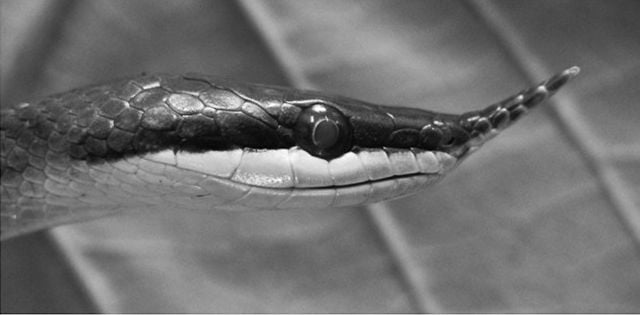
Gonyosoma hainanense has two loreal scales on each side, and the front one touches the internasals, the pair of scales just behind the tip of the snout. It has no black line at all.
The Pu Luong snake is an adult female, 1,096 mm long, of which 305 mm is tail. On its right side it has one loreal scale and a black line above the lips, just like G. boulengeri. On its left side it has two loreals, with the front one touching the internasals, just like G. hainanense. It has six scales on its horn, like G. hainanense, where G. boulengeri has five. And its tail makes up 28 percent of its length, more than the 24 to 25 percent measured in female G. boulengeri and within the range of G. hainanense.
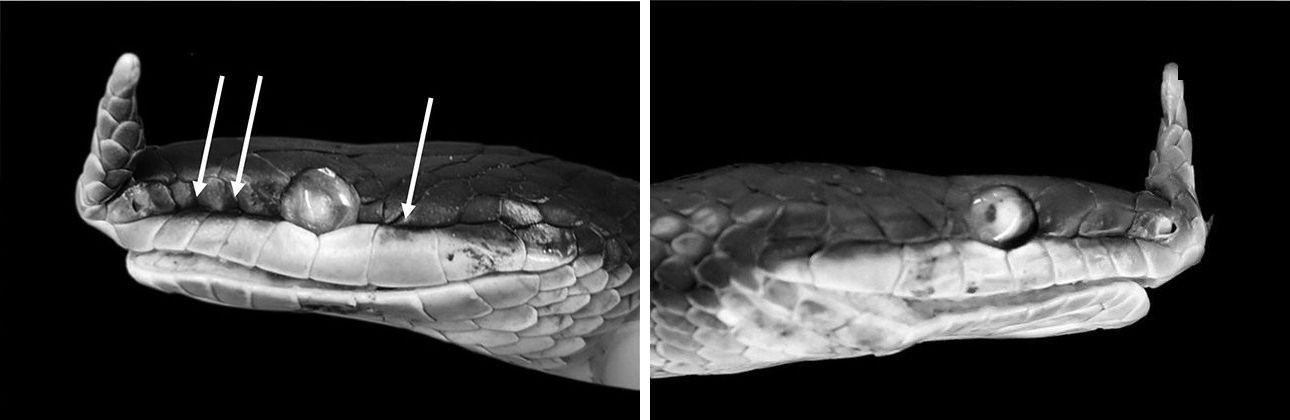
Almost every other feature, from the number of belly scales (220) to the rows of scales around the body, falls within the range of both species. The features that are supposed to settle the question contradict each other.
Three explanations
With only one snake, the team could not decide, and they said so plainly. Their paper sets out three possibilities.
The first is that the snake is simply an unusual G. boulengeri. The species has been recorded elsewhere in Thanh Hoa Province, though never before in Pu Luong Nature Reserve.
The second is that it belongs to an isolated population of G. hainanense. That would be surprising. Hainan Island lies more than 400 km from Thanh Hoa, and 280 km of that is open sea across the Gulf of Tonkin. The currents in the gulf make it very unlikely that a snake could drift from Hainan to northcentral Vietnam. But they could work the other way. When the Red River floods, its fresh water spreads out over the denser salt water of the gulf in a floating layer. Something similar happens in South America, where floodwater from Venezuela's Orinoco River reaches islands such as Trinidad and Tobago, a route by which animals are known to have reached those islands. If the same thing happened here, northcentral Vietnam could have been the source of Hainan's rhinoceros ratsnakes, not the other way round.
The third possibility is that the snake represents a species that has not yet been described.
"At this stage, the conflicting data of our specimen and the two named rhinoceros snakes do not allow us to place it into either species with confidence." — Dau et al. 2026
Each of these is a hypothesis that can be tested, and the way to test them is DNA. Until someone compares its genes with those of both named species, the Pu Luong snake will remain a snake between species.
The people who noticed
The work was done by Vinh Quang Dau, Thao Ngoc Hoang and Danh Ngoc Le of the Laboratory of Zoology at Hong Duc University in Thanh Hoa Province. Thao Ngoc Hoang led the paper as corresponding author. They preserved the snake and deposited it in their university's collection, where it is catalogued as HDU2025.2004 and can be re-examined by others. The exact spot where the bamboo was cut is not published, to protect these snakes from poachers.
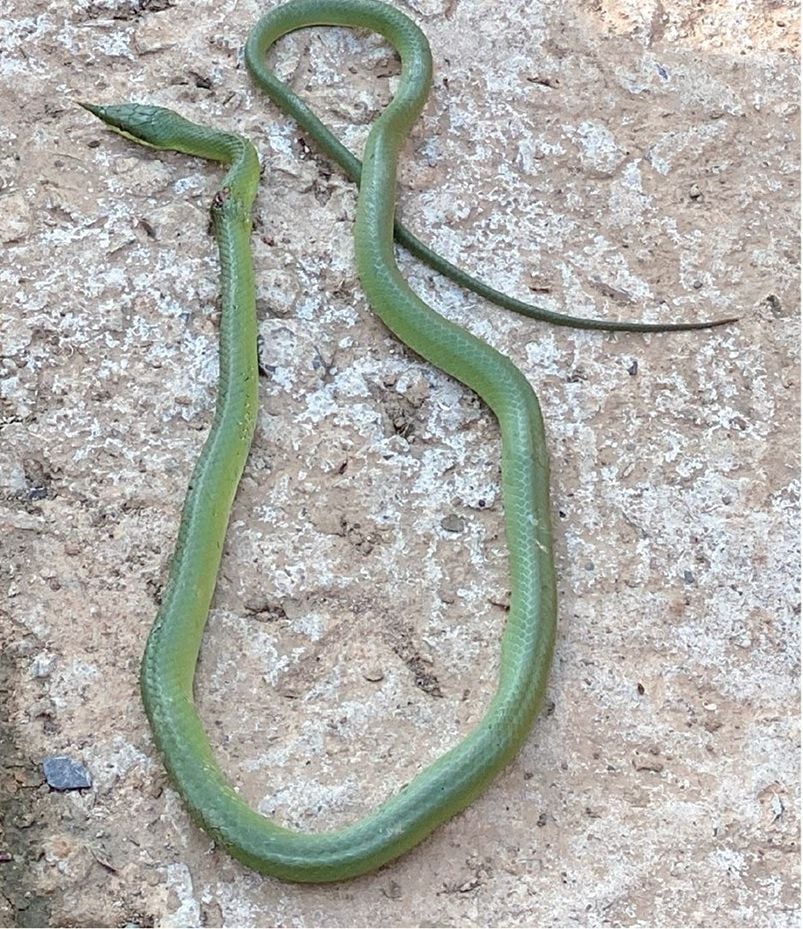
In life, the snake was a uniform green on the back, turning pale green on the sides. In preservative its back turned blue and its black lip line faded, though traces are still visible. A thin white line runs along the edge of its belly scales all the way to the tip of the tail.
I joined the team as a co-author. Besides the standard characters used for these snakes, the team also examined several that I had used with Mark O'Shea and Hinrich Kaiser in our 2019 description of a new groundsnake from West Papua. Three characters are evaluated here in detail for the first time: whether the loreal touches the internasals, how many scales make up the horn, and whether the pale stripe along the belly edge runs all the way to the tail tip. The team found that some of these can vary between individuals and even between the two sides of one head, and that they are often hard to see in photographs. Future studies will need to record them more carefully.
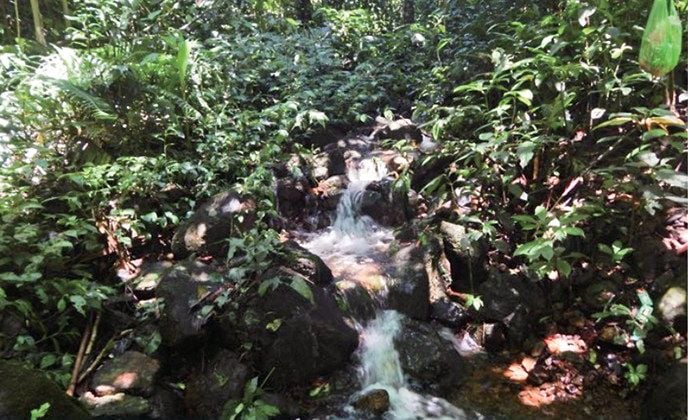
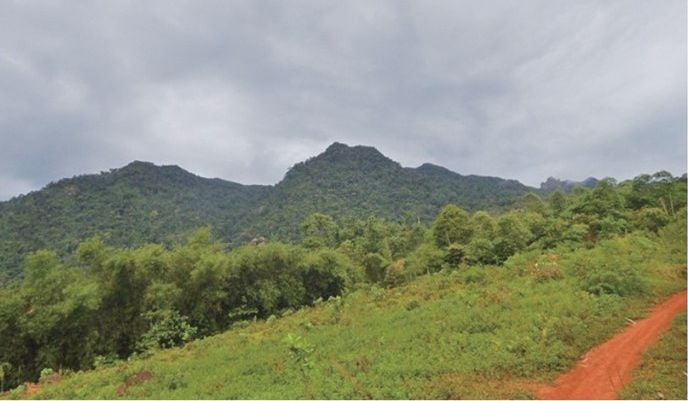
A single snake that a frightened homeowner killed has become a specimen in a university collection, a published puzzle and a reason to look again at the two rhinoceros ratsnakes, their faces and the sea between them. None of that would have happened without the villagers who passed the news on, and a team at Hong Duc University who took the trouble to look closely.
The papers
- (2026) A Rhinoceros Snake (Gonyosoma) caught between species: morphological assessment of an enigmatic specimen from Pu Luong Nature Reserve, northcentral Vietnam Current Herpetology 45(2): 234–241