The Lizards Time Left Behind
Photo: Matthew S. Rand, from Smith et al. 1991, Northwestern Naturalist
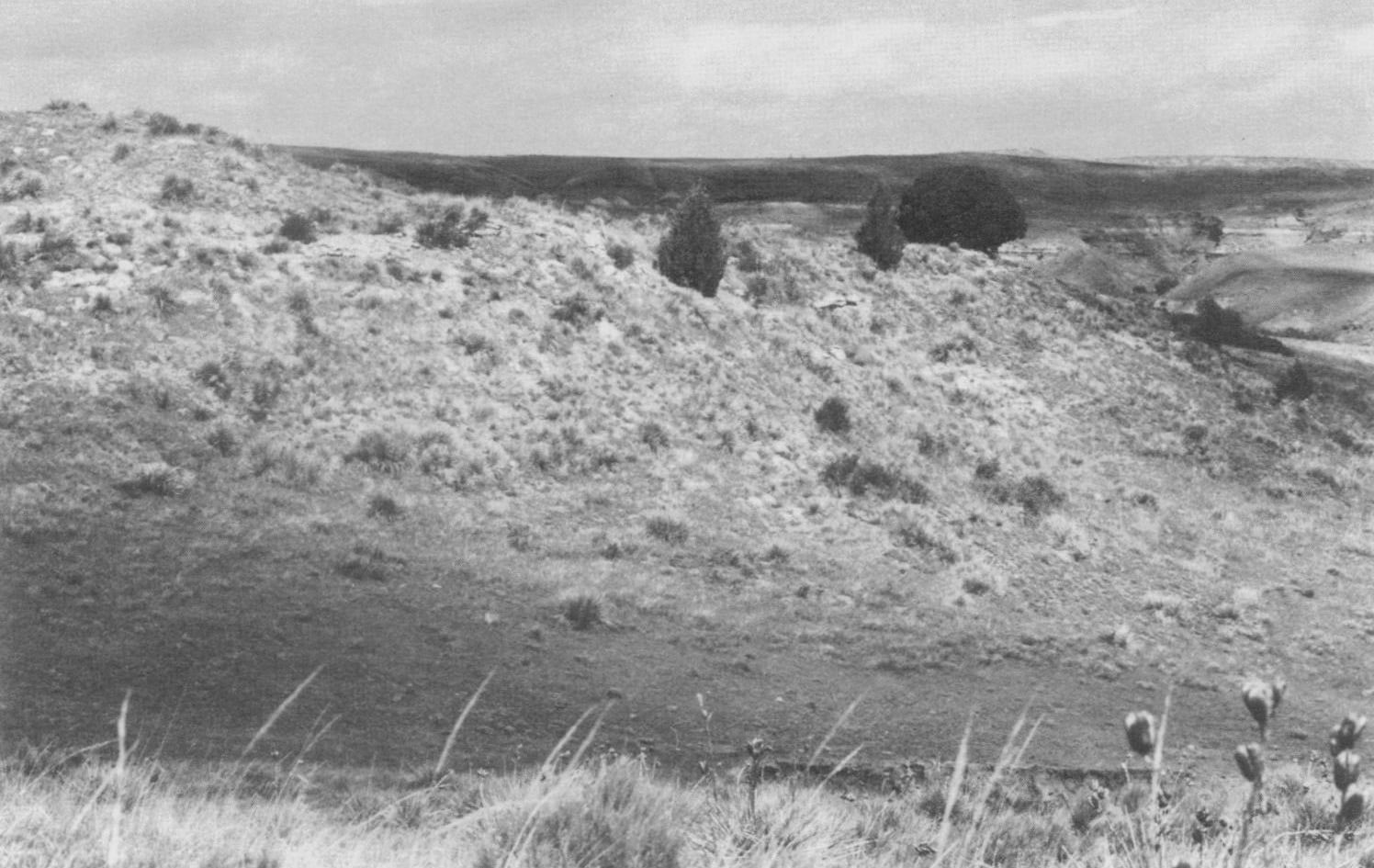
On 24 September 1989 I was walking the sandstone hills east of the small town of Agate, on the high plains of eastern Colorado, with J. David Drew and Hobart M. Smith. Hobart was two days short of his 77th birthday. He would become the most published herpetologist of all time, with more than 1,600 papers. We were looking for fence lizards, and the way to find them here was to trample the bushes that grow beside the sandstone slabs and wait for a lizard to dash out into the open.
We collected three lizards that day. They went into the University of Colorado Museum in Boulder, together with the 24 others that make up the sample for one of my first papers. The lizards themselves are the survivors of a story that began thousands of years ago.
Two lizards that were never supposed to meet
Two kinds of eastern fence lizard, Sceloporus undulatus, live in eastern Colorado. They were treated as subspecies, regional forms of one species that differ enough to have their own names.
The northern prairie lizard, S. u. garmani, is small and boldly striped. It lives mostly on the ground in the sandy prairie. The red-lipped plateau lizard, S. u. erythrocheilus, is bigger, with dark cross-bars instead of stripes. It climbs rocks in the wooded foothills of the Rocky Mountains, and in the breeding season the males have bright orange lips.
Nobody had ever found the two in contact. They were thought to have drifted so far apart that they could live side by side without interbreeding. Where two subspecies do meet and mix, the result is a population of intergrades: lizards that are, in one way or another, in between.
Found by accident
The lizards on the Palmer Divide were found by accident. The team had first searched the thick, whitish conglomerate rock that caps the eastern hills, hoping for red-lipped plateau lizards. There were none. The belt of crumbly Foxhills Sandstone a little to the west, only 1 to 2 metres thick where it caps the eroded hills, was searched "simply as a last resort," as we wrote. That is where the lizards were.
The sandstone belt runs for about 18 to 19 km and is at most 6 km wide. The lizards live all along it and nowhere beyond it. They were never seen on the flat sandy prairie away from the rock, and they always took cover in skunkbush growing at the side of sandstone slabs.
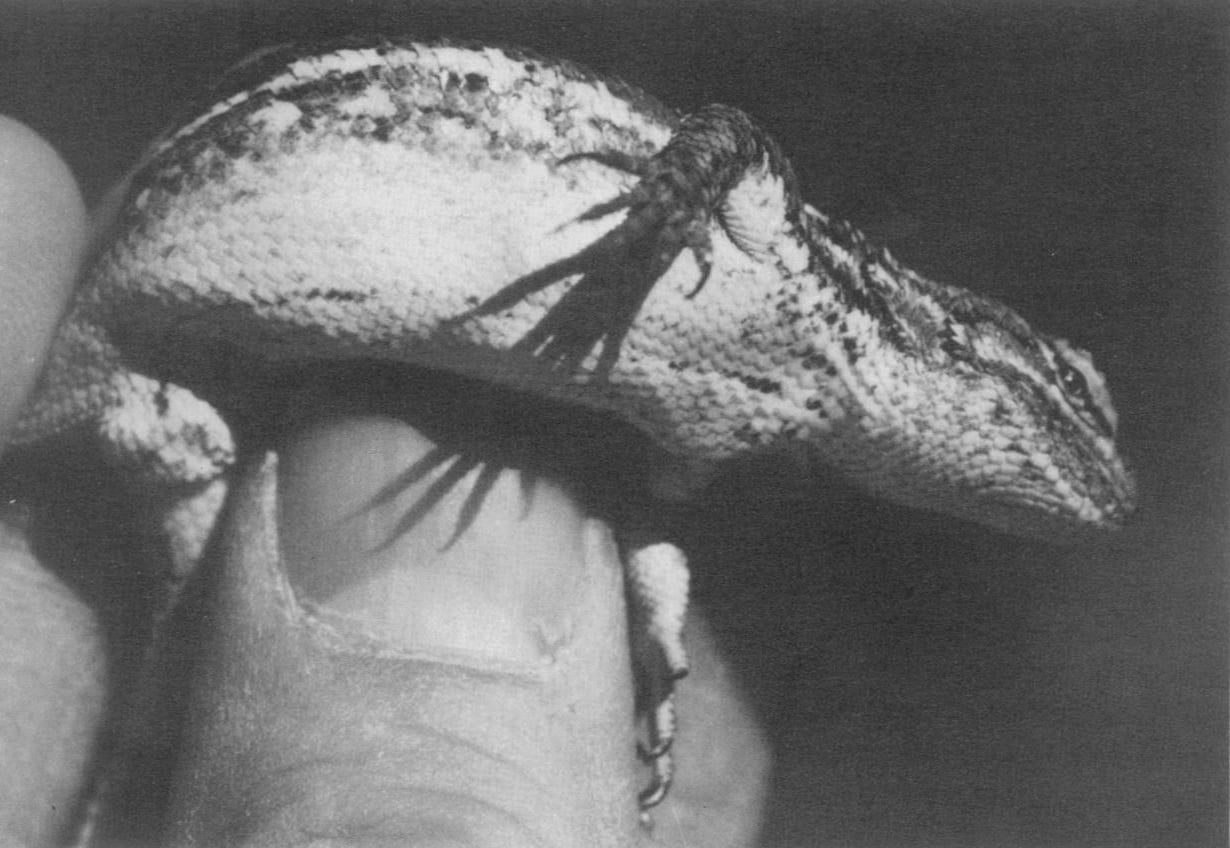
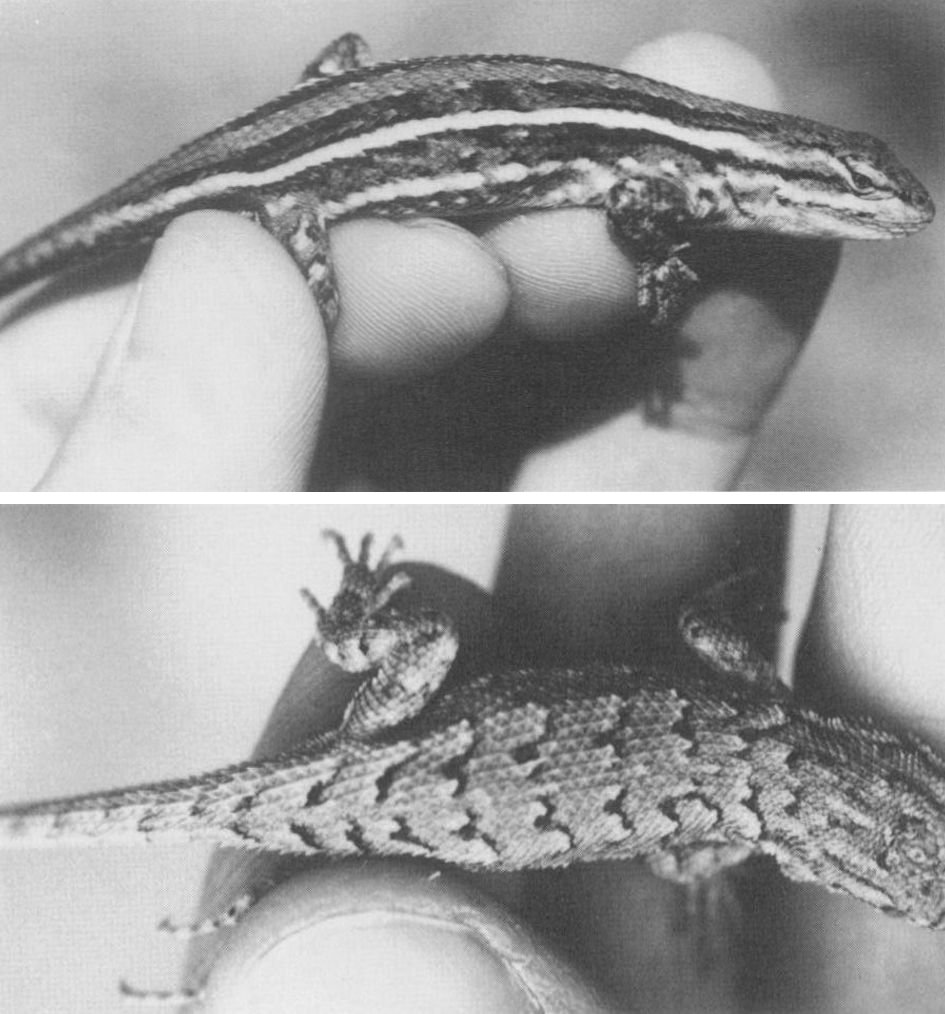
These lizards were a puzzle. In size, back pattern and scale counts they looked like prairie lizards. In where and how they lived, as rock-dwellers, they behaved like plateau lizards. Their belly and throat colours were in between, some males showed flecks of orange on their lips, and they had two features of their own: males with a black front surface on the thigh, and fewer scales between the two rows of pores under the thighs than either parent. That kind of mix, going beyond both parents in some features, is typical of populations formed when two forms meet for a second time.
A test with a hormone pellet
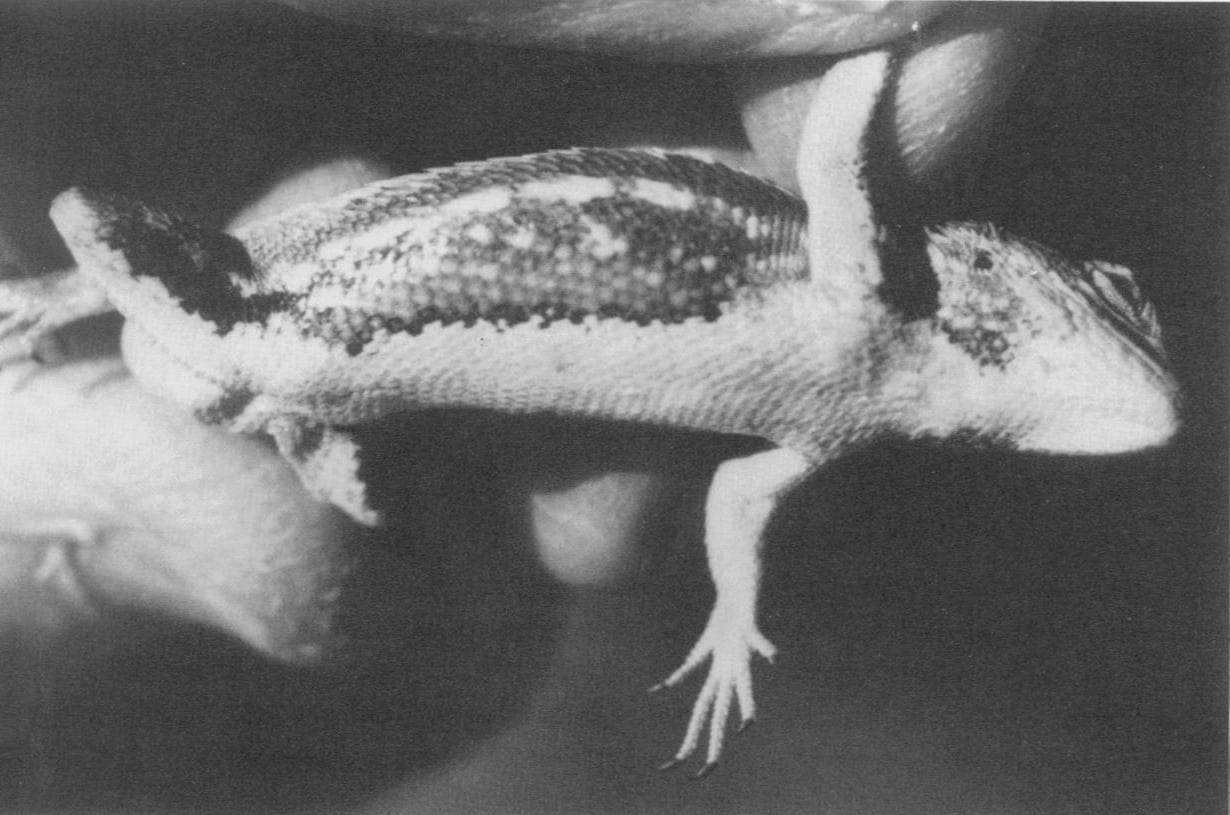
The lizards we caught in September were no longer in their breeding colours. To see what they would look like in spring, four males were given a small implant of the hormone testosterone on 18 October 1989. One of them was a lizard from our September day. By 22 November all four had grown bright blue belly patches edged in black, with the black spreading onto the front of the thighs. The throat patches appeared as well.
Eight females caught in June were kept until they laid their eggs. They laid only 2 to 4 eggs each, fewer than prairie lizards in Nebraska, which is not surprising at 1661 metres, with a short summer. Three eggs hatched after 44 days, into babies just 21.5 mm long from snout to vent.
Leftovers of an older climate
How did a population of in-between lizards end up stranded on a strip of sandstone, surrounded by more than 65 km of prairie in every direction? Our explanation followed the climate history of Colorado.
Between about 8,500 and 4,500 years ago the climate was warmer, and the ancestors of the two lizards probably met and mixed. Then it cooled, from about 4,500 to 3,100 years ago, and they were pushed apart. Between 3,000 and 2,000 years ago it warmed again, and the two met a second time and interbred. After that it cooled once more, and the in-between populations died out everywhere except here.
Why here? Most likely because of winter. The sandstone is full of crevices where reptiles can spend the winter below the frost line. The thick conglomerate nearby has no such hiding places, and the sandy prairie around it has too few burrows. So one small population held on.
We estimated that it lives in an area of probably no more than 65 square kilometres and numbers no more than several hundred lizards. We called it "a unique, irreplaceable population that merits protection," and added that "even scientific studies should be pursued with the utmost regard for its survival."
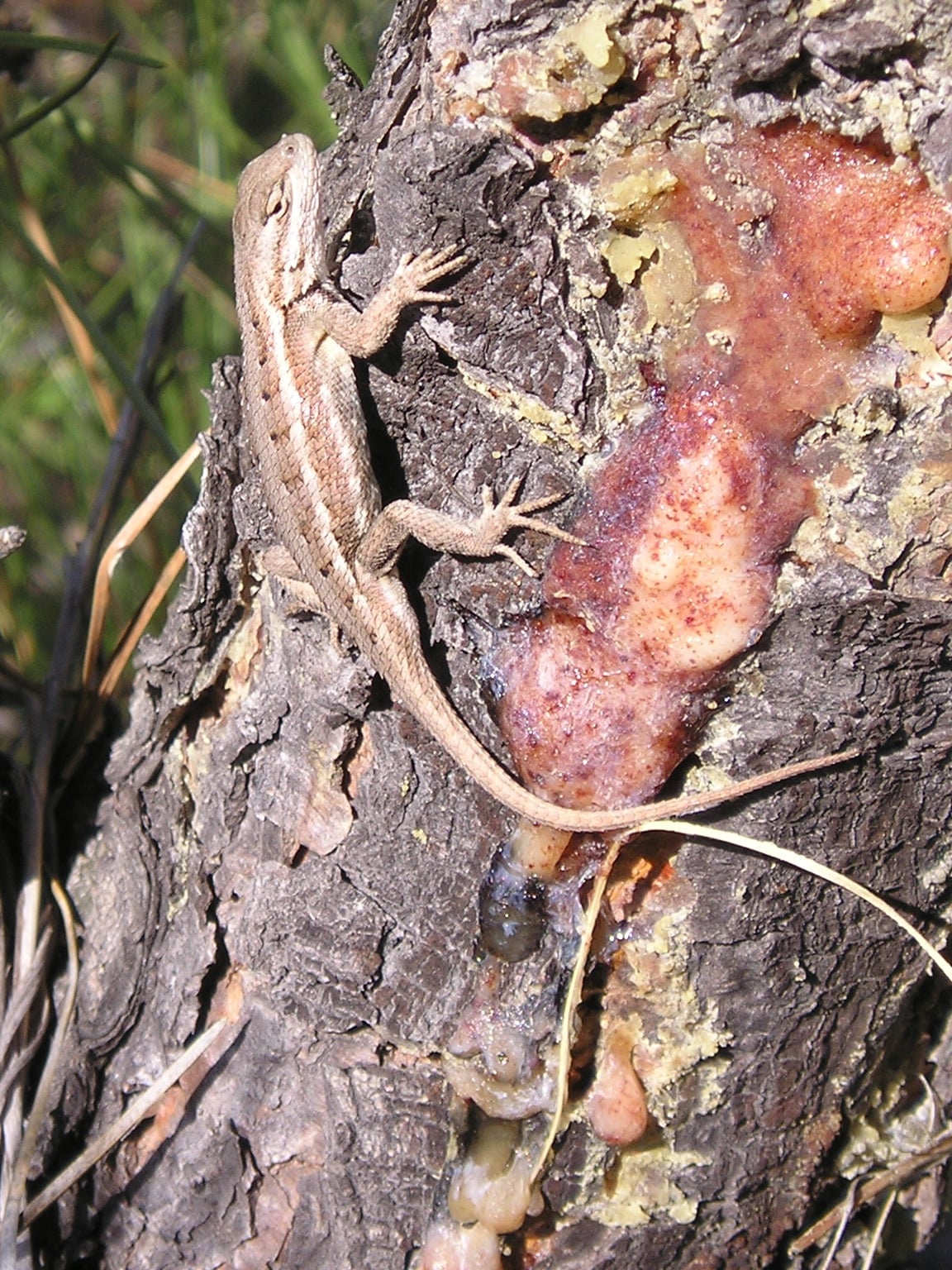
Since then, DNA studies have redrawn the family tree of the fence lizards. In 2002 Adam Leaché and Tod Reeder split Sceloporus undulatus into several species, and today most populations of both of our "parents" in eastern Colorado are placed in the prairie lizard, Sceloporus consobrinus.
My first paper: a salamander's toes
Before the lizards, there was a salamander. My very first paper, written with James Hanken at the University of Colorado and published in the Canadian Journal of Zoology in 1990, was about the Jemez Mountains salamander, Plethodon neomexicanus. It is a slender, lungless salamander that breathes through its skin and is found only in the Jemez Mountains of northern New Mexico, geographically isolated from its relatives.
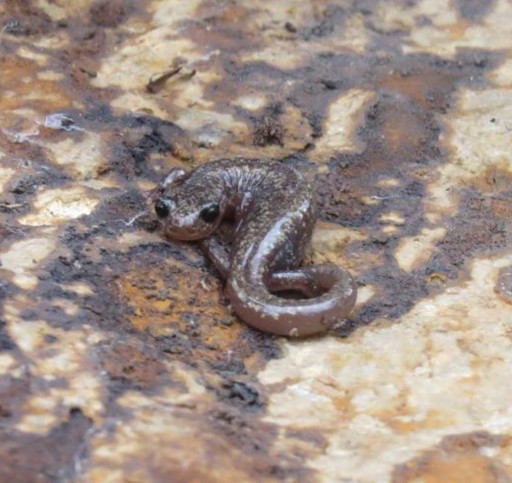
We looked at the bones of its legs and feet in 25 specimens that had been specially prepared, stained so that bone and cartilage stand out. Scientists describe a salamander's toes with a phalangeal formula: the number of small bones in each toe, from the first to the last. The hind foot of this species was supposed to have the formula 1-2-3-3-1, with a last toe reduced to a single bone. It was even considered a feature of the species.
It turned out that only a quarter of the hind feet actually had it. We found two hind-foot formulas and one front-foot formula that had never been reported, and six unusual arrangements of the small bones of the wrist and ankle. The salamander's limb skeleton turned out to be among the most variable known in any salamander. We suggested this variability might be very old, perhaps shared across the whole genus Plethodon.
The Jemez Mountains salamander has been listed as endangered under the US Endangered Species Act since 2013.
Why it matters
A lizard population on a strip of sandstone and a salamander on one mountain range are both small, isolated survivors. In both cases a careful look at many specimens, bone by bone and scale by scale, showed that the textbook picture was too simple. That kind of close looking runs through much of my later work, on frogs, groundsnakes and old museum specimens.
The papers
- (1990) Limb skeletal variation in the Jemez Mountains salamander, Plethodon neomexicanus Canadian Journal of Zoology 68: 1281–1287
- (1991) Relictual intergrades between the northern prairie lizard (Sceloporus undulatus garmani) and the red-lipped plateau lizard (S. u. erythrocheilus) in Colorado Northwestern Naturalist 72: 1–11